
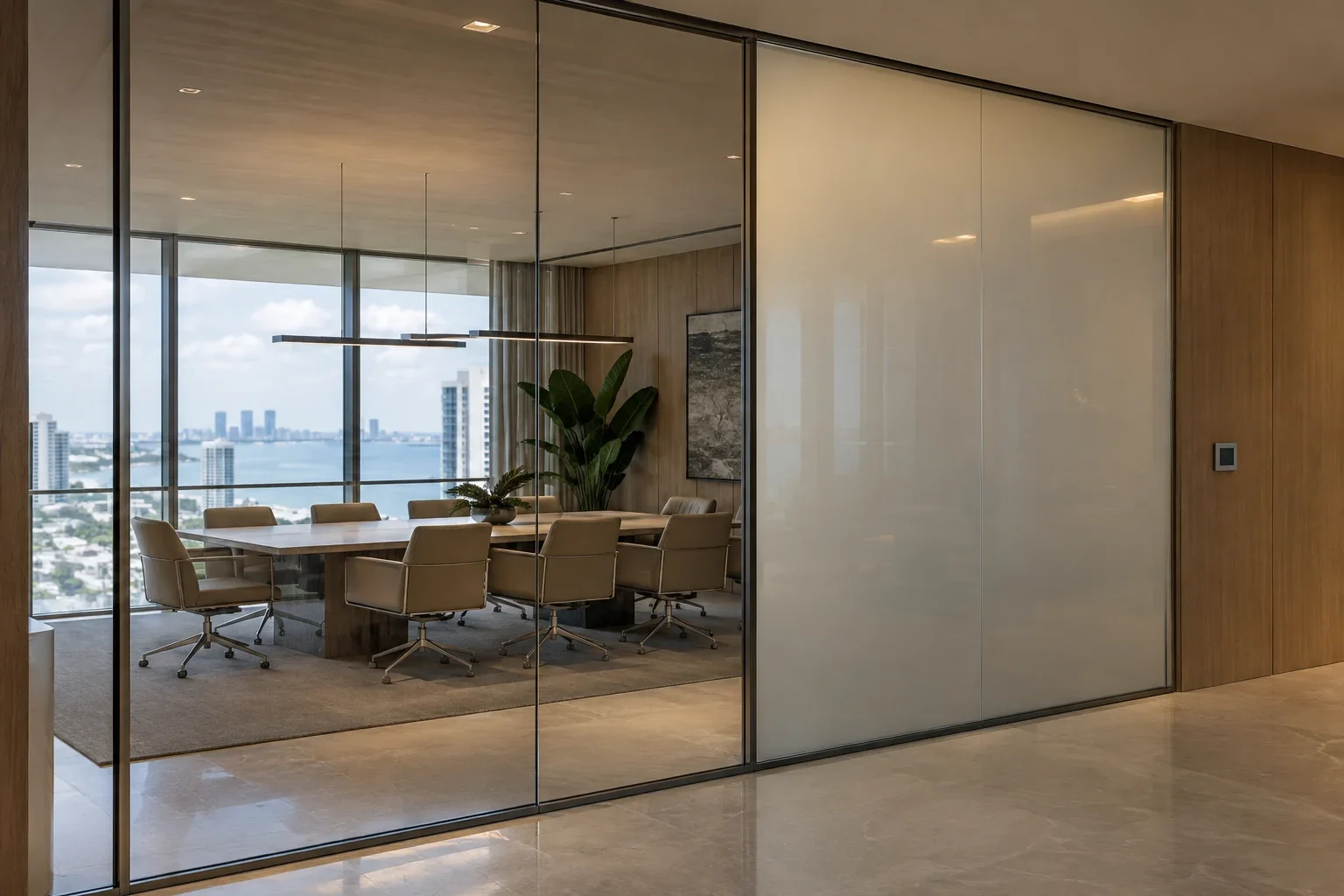
Smart glass is often purchased for a simple experience: press a button, change the privacy of a room. Delivering that experience, however, requires more than selecting a pane or ordering a roll of film. Measurements, fabrication, electrical planning, installation details and controls all influence how the finished system looks and functions.
For architects, commercial general contractors, interior designers and luxury homeowners, choosing a smart glass installation company is therefore as important as choosing the product. A turnkey partner connects the specification to the installed result instead of leaving the project team to assemble separate suppliers and troubleshoot the gaps.
Smart Glass Technologies makes that coordination its core service. From laser templating and custom fabrication in Miami to certified installation crews, low-voltage wiring, busbar concealment and automation integration, the company provides a complete installation approach—not a DIY kit.
Smart Glass Is a Building System, Not Just a Finish
A conventional glass selection focuses heavily on dimensions, appearance, mounting and the requirements of its location. Switchable glass adds electrical connections and control decisions to that scope. Retrofit smart film also requires careful attention to the existing glass, application conditions and perimeter detailing.
These considerations meet at the edges of the installation. A frame may need to accommodate a wiring route. A visible glass edge may require a discreet connection detail. An automation command must correspond to the intended privacy behavior. When these decisions are made separately, the finished installation can suffer even if the product itself is appropriate.
A turnkey process brings those decisions together before fabrication and field work. For a primer on the underlying technology, explore how smart glass works. The key purchasing lesson is straightforward: specify both the product and the process needed to install it.
What Turnkey Installation Should Include
Laser templating and project-specific fabrication
Accurate measurements establish the relationship between the glass, its surrounding construction and its electrical connections. Laser templating helps translate field conditions into fabrication information, particularly where openings or architectural details require custom work.
Smart Glass Technologies performs custom fabrication in Miami, Florida, where its headquarters and manufacturing operations are located. Its products are made in the USA. Connecting templating with fabrication allows the team to address project-specific dimensions and connection details within a coordinated workflow.
Certified installation crews
Installation is where drawings meet real site conditions. Handling the material, aligning it within the opening, protecting adjacent finishes and completing the perimeter details all affect the result. Retrofit film has its own application requirements and should not be treated as an ordinary decorative film.
Smart Glass Technologies uses certified installation crews and has local installers across 26+ US metros. Confirming availability through the service-area check is a useful early step, especially when construction scheduling depends on specialist trade access.
Low-voltage wiring and busbar concealment
Busbars are conductive components that deliver electrical power to the switchable material. Their location, together with the wiring route, deserves attention during design—not after adjacent finishes are complete.
Turnkey service includes low-voltage wiring and busbar concealment. The practical benefit is a deliberate connection detail rather than a last-minute attempt to hide an electrical component. Project teams should still confirm the boundaries between the smart glass scope and the work assigned to the project's electrical contractor.
Automation integration
A wall control, a room-control interface and a broader automation system can each create different expectations for daily use. Smart Glass Technologies provides integration with Lutron, Crestron and Control4, allowing the control approach to be considered alongside the architecture.
Discuss which panels should operate together, who should have access to the controls and what state is desired when power is off. Those choices help determine both the product selection and the integration scope.
Turnkey Service Versus a Product-Only Purchase
A product-only purchase is not the same scope as an installed system. The difference becomes clear when responsibilities are compared, particularly on projects involving multiple trades.
| Project responsibility | Product-only purchase | Turnkey installation approach |
|---|---|---|
| Field measurements | The buyer must arrange accurate dimensions and resolve discrepancies. | Laser templating connects field conditions with fabrication. |
| Custom fabrication | The buyer coordinates product dimensions and site requirements with separate parties. | Custom fabrication is coordinated within the installation workflow. |
| Installation labor | The buyer sources a suitable installer and defines the scope. | Certified crews perform the specialist installation. |
| Wiring and visible connections | Trade responsibilities and concealment details must be separately assigned. | Low-voltage wiring and busbar concealment are planned as part of the service. |
| Automation | The buyer coordinates the product supplier with the controls team. | Integration requirements are addressed within the turnkey scope. |
| Warranty documentation | Product and installation coverage may come from different parties. | Product and installation warranty terms are provided with the quote. |
Turnkey does not eliminate the need for coordination with the architect, general contractor or other trades. It gives the smart glass portion of that coordination a defined service provider and a clearer scope of responsibility.
Product Selection Changes the Installation Plan
The PriWatt™ range includes retrofit film and replacement glazing, with standard and reverse operating behavior. Choosing between them requires more than comparing appearance in a demonstration.
Retrofit film for existing glass
PriWatt Smart Film is a self-adhesive PDLC product that is frosted when off. It provides a retrofit route where the existing glass is suitable, avoiding the need to choose replacement glazing solely to introduce switchable privacy.
PriWatt Reverse Smart Film uses PNLC technology and is clear when off. That distinction matters wherever the unpowered state is part of the design intent. The installation review should address the existing surface, edge conditions and practical wiring route before confirming the retrofit approach.
Smart glass for a new glazing assembly
PriWatt Smart Glass is available as PDLC laminated glass or an insulated glass unit. PriWatt Reverse Smart Glass uses PNLC technology. These products bring the glazing assembly itself into the specification, making early coordination with framing and surrounding construction especially valuable.
Available smart glass formats include doors, shower doors, office partitions, room dividers, windows, skylights, curved glass, railings and rear projection. Each application warrants its own review. A successful office partition detail should not simply be copied into a shower enclosure or skylight without evaluating the different conditions.
Compare Installed Scope, Not Just Material Price
A material price is useful for initial budgeting, but it does not describe the complete construction scope. A meaningful comparison identifies the selected product, installation labor, connection details and integration responsibilities.
PriWatt Smart Film is $70/sq ft, plus $30/sq ft for installation. PriWatt Reverse Smart Film is $120/sq ft. PriWatt Smart Glass is $145/sq ft, while PriWatt Reverse Smart Glass is $185/sq ft. Glass installation is $50–$100/sq ft.
These published prices should be read alongside a project-specific quote rather than treated as interchangeable installed totals. In particular, confirm the installation scope for reverse film and clarify how wiring, concealment, controls and site conditions are addressed. Visit the smart glass cost guide for pricing context.
A less expensive material proposal may leave work for other trades. The useful question is not simply which supplier has the lowest product price, but which proposal clearly accounts for the system you expect to receive.
A Practical Checklist for Selecting Your Installation Company
Before approving a proposal, use this checklist to identify missing decisions and make bids easier to compare:
- Confirm the application: Identify whether the project involves existing glass, replacement glazing or a new assembly.
- Define the unpowered state: Decide whether frosted-when-off or clear-when-off behavior supports the intended use.
- Assign measurement responsibility: Establish who verifies field conditions and approves fabrication dimensions.
- Review visible details: Request a clear plan for busbar concealment, wiring routes and perimeter finishes.
- Clarify electrical boundaries: Identify what the smart glass team handles and what remains with the project electrician.
- Specify controls: Document panel grouping and any Lutron, Crestron or Control4 integration requirements.
- Confirm site readiness: Agree on access, adjacent work and protection requirements before installation is scheduled.
- Verify local service: Check installer availability for the project location.
- Read the warranty: Review product and installation coverage separately, including the written terms.
- Plan the handover: Agree on a demonstration of switching behavior and controls before project closeout.
Experience and Warranty Should Support the Installation Promise
Founded in 2018, Smart Glass Technologies has installed 200,000+ sq ft and is UL and SGCC certified. Those credentials provide useful context when evaluating the company, while the project quote should establish the specific product and installation scope being purchased.
Warranty coverage is also part of that evaluation. PriWatt Glass carries a 3-year warranty, PriWatt Film carries a 2-year warranty, and installation carries a 1-year warranty. Written terms accompany every quote. Review the warranty information and the terms for your project rather than assuming product coverage and workmanship coverage are identical.
Choose the Team That Connects Design to Installation
The best reason to choose a turnkey smart glass installation company is continuity. Measurements inform fabrication, fabrication supports installation, and wiring and controls are planned around the finished architecture. That connected approach helps protect both the design intent and the practical experience of using the space.
Smart Glass Technologies brings those responsibilities together through its turnkey service. Request project pricing to discuss your application, installation details and control requirements.
Frequently Asked Questions
What does turnkey smart glass installation include?
Smart Glass Technologies provides laser templating, custom fabrication in Miami, certified installation crews, low-voltage wiring, busbar concealment and automation integration. Your quote should define the project-specific scope and any responsibilities that remain with other trades.
Can smart glass technology be installed on existing windows or partitions?
PriWatt Smart Film is a self-adhesive retrofit option for suitable existing glass. The installation team should review the glass surface, perimeter conditions and wiring route before confirming suitability.
Can Smart Glass Technologies integrate with home automation?
Yes. Smart Glass Technologies provides integration with Lutron, Crestron and Control4. Discuss panel grouping, control locations and the desired unpowered state during planning.
What warranties apply to products and installation?
PriWatt Glass has a 3-year warranty, PriWatt Film has a 2-year warranty, and installation has a 1-year warranty. Written terms are provided with every quote.
How should I compare smart glass installation quotes?
Compare the complete scope, not only the material price. Confirm measurement responsibility, fabrication, installation labor, low-voltage wiring, busbar concealment, automation requirements and warranty terms. Identify any work assigned to your general contractor or electrician.