
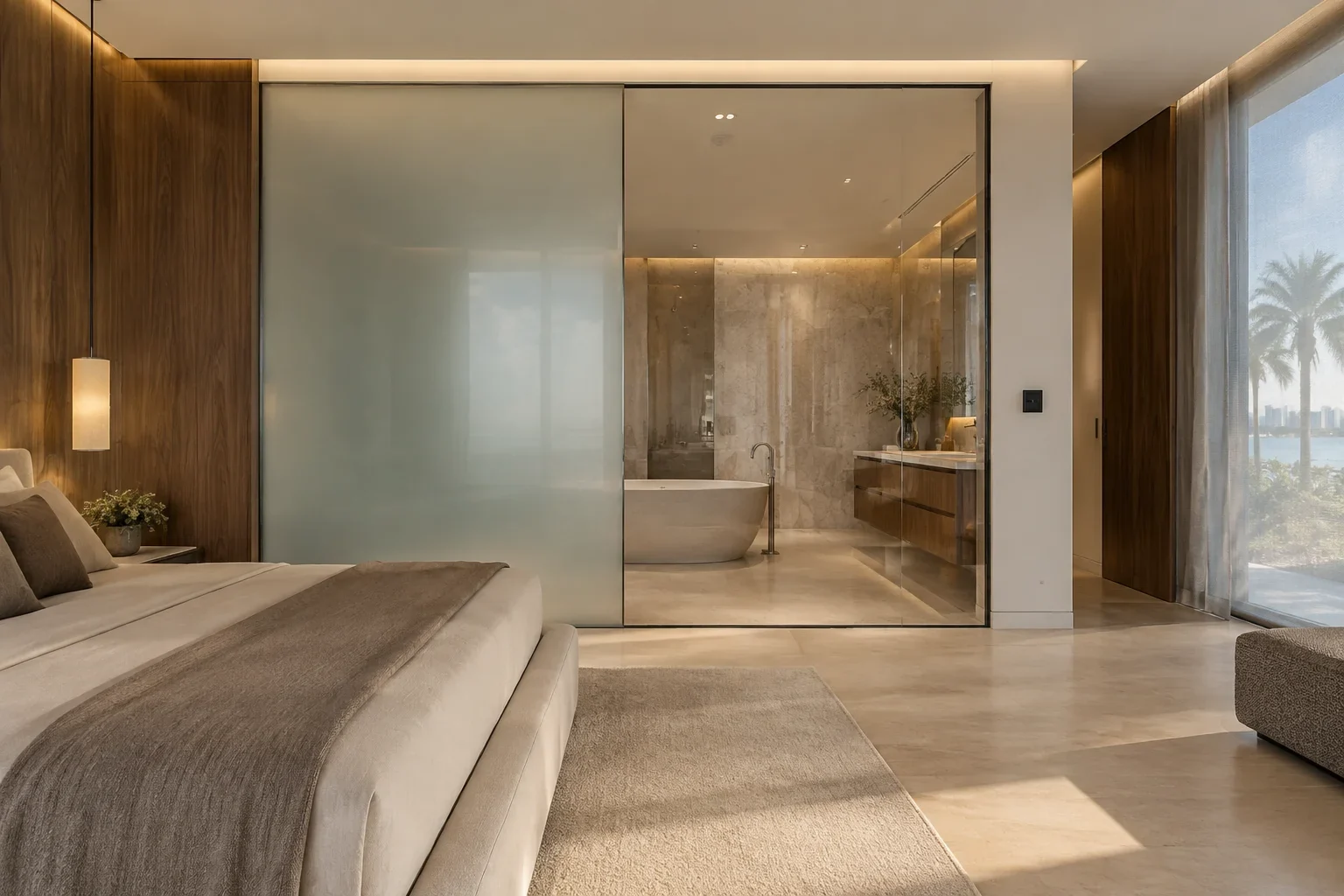
Make Privacy Part of the Room’s Control System
A beautifully designed room should not need a separate routine for every feature. Lighting, shades and privacy glass can work together, whether the setting is a luxury primary suite, an executive office or a glass-enclosed conference room. Smart glass home automation brings switchable privacy into that coordinated experience.
With Lutron, Crestron or Control4, a smart glass installation can be designed around familiar controls and carefully planned scenes. The important distinction is that integration is not simply a matter of attaching film and adding an app. Glass selection, electrical interfaces, concealed connections and programming must all be coordinated.
That is where Smart Glass Technologies focuses its service: a complete turnkey installation, from laser templating and custom fabrication in Miami to certified installation crews, low-voltage wiring, busbar concealment and automation integration. We are not a DIY kit seller.
How Smart Glass Home Automation Works
Switchable privacy products use an electrically controlled layer to change the appearance of glazing. PriWatt™ Smart Film and PriWatt Smart Glass use PDLC technology and are frosted when off. PriWatt Reverse Smart Film and PriWatt Reverse Smart Glass use PNLC technology and are clear when off.
The automation system sends a command through a compatible control arrangement to the smart glass power equipment. The glazing then changes state according to the selected product and control design. The exact interface depends on the automation hardware, power equipment and intended operation; it should be confirmed before procurement.
Do not assume a smart glass power supply can connect directly to an ordinary lighting dimmer. The installation team and automation integrator should verify the appropriate switching method, electrical requirements and supported behavior. For a closer look at the underlying technology, visit how smart glass works.
Privacy Is Different from Solar Shading
Switchable privacy glazing should not automatically be treated as blackout glass or a substitute for solar-control shading. A frosted appearance scatters light, but perceived privacy can still depend on lighting, viewing conditions and proximity to the glass. Discuss the actual application and review suitable samples before finalizing the specification.
Planning Integration with Lutron, Crestron and Control4
Each platform can be part of a coordinated smart glass project. The best approach depends on the existing system, available control hardware and responsibilities of the automation contractor. A platform name alone does not establish compatibility with every component or guarantee a particular feature.
| Platform | Design opportunity | What to coordinate |
|---|---|---|
| Lutron | Include privacy glass in a lighting-and-shading experience, such as an evening or meeting scene. | Confirm the installed Lutron system, compatible control interface, keypad behavior and relationship to shade scenes. |
| Crestron | Incorporate glazing into broader room control alongside lighting, presentation equipment and other programmed functions. | Define the interface, programming scope, user controls and any available status feedback. |
| Control4 | Make privacy part of daily home routines and room-based controls. | Confirm supported integration hardware, scene assignments, local operation and behavior if the automation system is unavailable. |
Lutron: Coordinate Privacy with Light
For a project centered on lighting and shading, smart glass can become another element of the room’s intended atmosphere. An evening scene might soften the lighting, adjust shades and command a bathroom partition to its privacy state. The Lutron integrator should establish how that command is delivered and how occupants can change privacy without disturbing the rest of the scene.
Crestron: Define the Room Experience
In a conference room or extensively automated residence, Crestron integration can organize multiple functions around a single activity. A meeting scene could request privacy while adjusting lights and preparing presentation equipment. Specify whether the control screen merely issues a command or can display verified glazing status; feedback should never be assumed without a confirmed design.
Control4: Keep Everyday Operation Simple
For a connected home, the goal is intuitive operation rather than more controls to learn. A Control4 project can be planned around routines such as getting ready, entertaining or settling in for the evening. Your integrator should confirm the supported method and make individual room privacy easy to operate independently of whole-home scenes.
Choose the Right Product Before Programming Scenes
The product’s unpowered state is an important design decision. Standard PriWatt PDLC products are frosted when off; reverse PriWatt PNLC products are clear when off. That difference affects daily operation, power-loss behavior and the logic behind every privacy command.
For an existing glass partition, self-adhesive PriWatt Smart Film offers a retrofit approach, subject to assessment of the glazing and installation conditions. For new construction or a glazing replacement, PriWatt Smart Glass is available as laminated glass or an insulated glass unit. Product suitability must be reviewed for the specific location and assembly.
Applications include doors, office partitions, room dividers, windows and skylights, with other architectural formats available. Explore smart glass formats early so the privacy concept aligns with the glazing package rather than becoming a late electrical addition.
Scenes That Serve Real Spaces
Primary Suites and Bathrooms
A privacy scene can coordinate a glazed bathroom partition with lighting and shades. Define who controls the glass and which commands take priority. An unrelated whole-home scene should not unexpectedly remove privacy from an occupied bathroom. For shower-door applications, confirm the appropriate product, detailing and installation requirements specifically for that environment.
Offices and Conference Rooms
A meeting-room scene can change the glass appearance while preparing the room for use. Keep a clearly understood local control available for occupants who do not use the building’s main interface. Remember that visual privacy is not acoustic privacy; sound isolation requires separate consideration of the glazing assembly, doors, seals and surrounding construction.
Open-Plan Living Spaces
Switchable room dividers can make an open interior feel more private without permanently closing sightlines. Plan how individual panels or groups should operate. Grouped control may suit a continuous partition, while separate control may better serve rooms with different occupants or activities.
Why Turnkey Installation Matters
The most visible part of smart glass is the changing surface. The lasting quality of the installation also depends on less visible work: accurate measurements, fabrication, cable routes, concealed electrical connections and accessible service locations. These details are difficult to resolve cleanly after finishes are complete.
Smart Glass Technologies brings those tasks into a turnkey scope. Laser templating and custom fabrication in Miami support a project-specific fit. Certified crews handle installation, low-voltage wiring and busbar concealment, while automation integration is coordinated with the project’s control requirements. Busbars are the conductive connection areas that deliver power to the switchable layer; concealing them is an architectural detail, not an afterthought.
For architects and interior designers, this approach helps protect the visual intent. For general contractors, it creates a coordinated smart glass scope instead of leaving a collection of disconnected components for different trades to resolve. For homeowners, the objective is straightforward: finished privacy glazing that operates as intended.
Headquartered and manufacturing in Miami, Florida, Smart Glass Technologies was founded in 2018 and has installed more than 200,000 square feet. Its products are made in the USA, with UL and SGCC certifications and local installers across more than 26 US metros. Check your service area when assembling the project team.
A Practical Buyer Checklist
- Document the glazing: Identify existing versus new glass, dimensions, framing and intended application.
- Select the unpowered state: Decide whether frosted-off PDLC or clear-off PNLC better fits the room.
- Identify the automation system: Share the platform, installed hardware and integrator’s contact information.
- Confirm the interface: Approve compatible power and control equipment before ordering.
- Plan concealed wiring: Coordinate cable paths, busbar concealment and service access before finishes close.
- Define control zones: Specify which panels operate together and which need independent commands.
- Protect privacy: Establish scene priorities, local controls and expected behavior during power or control-system interruptions.
- Plan commissioning: Test scenes, local operation and restoration behavior, then document the controls for occupants.
- Review the written scope: Confirm installation, automation responsibilities, exclusions and warranty terms.
Budget for an Installed System, Not Just Glass
PriWatt Smart Film is $70 per square foot, plus $30 per square foot for installation. PriWatt Reverse Smart Film is $120 per square foot. PriWatt Smart Glass is $145 per square foot, and PriWatt Reverse Smart Glass is $185 per square foot. Glass installation is $50–$100 per square foot.
These product prices are not a substitute for a project-specific integration quote. Confirm reverse-film installation, automation interfaces, programming and related construction scope in writing. See the smart glass cost guide for budgeting context.
Warranty coverage is three years for PriWatt Glass, two years for PriWatt Film and one year for installation. Written terms accompany every quote; review the warranty information alongside the proposed scope.
Bring the Glass and Automation Teams Together Early
The best smart glass home automation feels simple because the technical decisions were made before installation. Start with the room’s privacy needs, verify the platform interface and coordinate the architectural details through a turnkey team.
Request pricing from Smart Glass Technologies to plan your glazing, installation and Lutron, Crestron or Control4 integration together.
Frequently Asked Questions
Can smart glass integrate with Lutron, Crestron and Control4?
Yes. Smart Glass Technologies provides automation integration with these platforms as part of its turnkey service. The specific system hardware, smart glass power equipment and control interface must be reviewed to confirm the integration design.
Can I connect smart glass to a standard lighting dimmer?
Do not assume a standard lighting dimmer is suitable. The smart glass installation team and automation integrator should confirm the approved power equipment and control method before wiring or procurement.
What happens to automated smart glass when power is lost?
Standard PriWatt PDLC Smart Film and Smart Glass are frosted when off. PriWatt Reverse PNLC Smart Film and Smart Glass are clear when off. Choose the product based on the room’s privacy needs and specify how controls should behave when power returns.
Can existing glass be added to a smart home privacy scene?
Existing glazing may be suitable for retrofit PriWatt self-adhesive Smart Film, subject to an installation assessment. Integration also requires coordinated power equipment, concealed wiring and a compatible automation interface.
What does Smart Glass Technologies’ turnkey service include?
The service includes laser templating, custom fabrication in Miami, certified installation crews, low-voltage wiring, busbar concealment and automation integration. The project quote defines the installation scope and coordination responsibilities.