
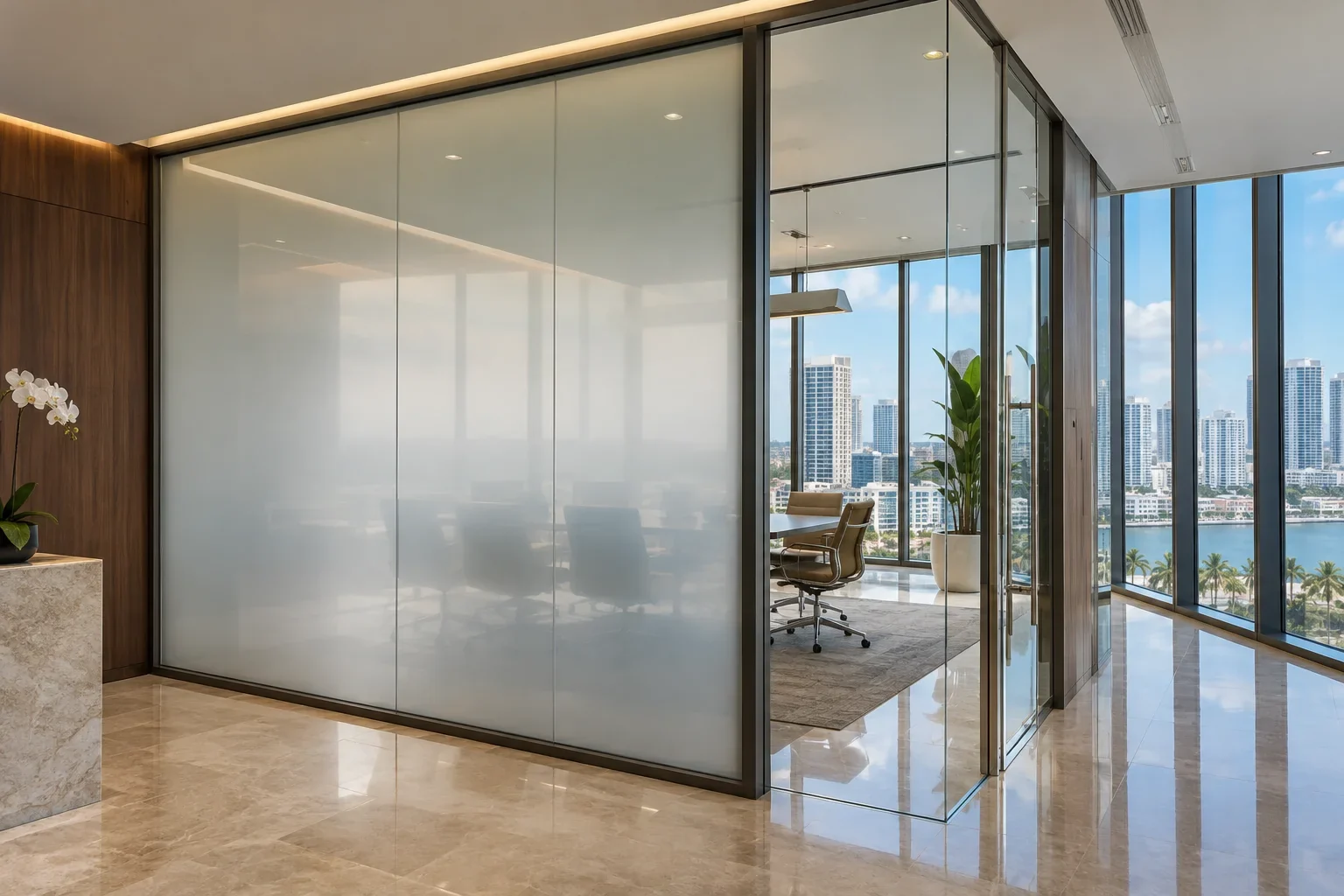
Comparing electrochromic vs PDLC smart glass starts with a practical question: do you need to manage sunlight or create privacy? Both technologies change the appearance of glazing electrically, but they solve different architectural problems. Treating them as interchangeable can lead to an expensive mismatch between what a project needs and what its glass actually does.
For architects, commercial general contractors, interior designers and luxury homeowners, the buying decision also extends beyond the glazing itself. Fabrication, electrical coordination, finished edges and control integration all affect the result. Smart Glass Technologies focuses on that complete scope, delivering PriWatt™ privacy solutions through turnkey installation rather than selling DIY kits.
Electrochromic vs PDLC: The Fundamental Difference
Electrochromic glass changes its tint to manage light and solar exposure. It is commonly considered for exterior glazing where glare, daylight and views must be balanced. A tinted pane generally remains see-through, so darkening should not be confused with creating a visual privacy screen.
PDLC glass changes how light passes through the glazing by switching between a frosted appearance and a clearer state. It is primarily a privacy technology. In PriWatt Smart Film and PriWatt Smart Glass, the unpowered state is frosted. When powered, the material becomes clearer, allowing views through the glazing.
That distinction should guide the specification before aesthetics, controls or pricing enter the discussion. A conference room that needs visual separation has a different requirement from an exterior window exposed to afternoon glare. Learn more about the underlying principles in our guide to how smart glass works.
| Buying consideration | Electrochromic glass | PDLC smart glass or film |
|---|---|---|
| Primary purpose | Daylight, glare and solar management | Switchable visual privacy |
| Visible change | Transitions between lighter and darker tint states | Transitions between frosted and clearer states |
| View through the glass | Generally preserves a view while tinting | Obscures the view in the frosted state |
| Typical project fit | Exterior windows and solar-exposed glazing | Office partitions, doors and interior room dividers |
| Retrofit approach | Commonly evaluated as a glazing replacement | Self-adhesive film may retrofit suitable existing glass |
| Power-state planning | Confirm behavior with the selected manufacturer | Standard PriWatt PDLC products are frosted when off |
| Critical specification question | How should the glazing respond to sunlight? | When and where is visual privacy needed? |
When Electrochromic Glass Makes Sense
Electrochromic glazing is worth evaluating when sunlight is the principal design challenge. In a bright office perimeter, glazed living space or sun-exposed circulation area, adjustable tint can help balance daylight and glare while retaining an outward view.
Its value depends on the whole building context. Orientation, surrounding shade, glazing construction and the control strategy all influence the outcome. Ask the proposed supplier to explain how the selected assembly supports the project’s solar and daylight objectives rather than relying on broad claims about smart glass.
Do not specify tint as a substitute for privacy
A darker window is not necessarily a private window. Visibility depends on lighting conditions on either side, and tinted glazing can still allow occupants or objects to be seen. If the brief calls for a meeting room to become visually enclosed, electrochromic tint alone should not be assumed to meet that requirement.
Likewise, do not assign energy or UV performance based solely on the technology name. Those considerations belong to the specific glazing assembly and its supporting documentation.
When PDLC Is the Better Fit
PDLC is a natural fit when a space should feel open at some times and visually separated at others. Examples include office partitions, private consultation spaces, bedroom-to-bathroom divisions and residential room dividers. Instead of adding a separate fabric or slatted covering, the glazing itself changes appearance.
PriWatt Smart Film provides a retrofit route for suitable existing glass. PriWatt Smart Glass incorporates PDLC into laminated glass or an insulating glass unit, making it an option to evaluate for new construction or glazing replacement. The choice is therefore not just electrochromic versus PDLC; it is also retrofit film versus a new glass assembly.
Set realistic expectations for frosted privacy
Frosted PDLC obscures the view, but it is not a blackout material. Light can still pass through, and silhouettes may be visible depending on lighting, proximity and installation conditions. Review a sample under conditions resembling the finished space, especially where occupants may stand close to the glass.
The powered state also deserves a sample review. Appearance can vary with viewing angle, lighting and the surrounding glazing. For premium interiors, approving the visual result early is more useful than treating the word “clear” as a promise of an invisible material.
Match the Technology to the Application
Commercial offices and meeting rooms
For internal meeting rooms, PDLC addresses the need to switch between openness and visual privacy. Coordinate room controls with the intended user experience and clarify the desired behavior when power is off. If the room also has solar-exposed exterior windows, glare control should be considered separately.
Visual privacy does not establish acoustic privacy. Sound isolation depends on the complete partition, including glass, framing, doors, seals and surrounding construction. Do not infer an STC rating from a switchable layer.
Luxury residences and bathrooms
PDLC can support a clean interior design where conventional window treatments would interrupt the architecture. Bathroom partitions and shower-door applications require careful attention to moisture exposure, edge protection, electrical routing and maintenance access. Confirm the appropriate product and assembly for the location rather than assuming every film installation is suitable for wet areas.
Windows, skylights and specialty glazing
For windows and skylights, identify whether the priority is privacy, solar management or both. Curved glass, railings and other specialty applications also bring fabrication and safety considerations that must be reviewed independently of the switchable effect. Explore available smart glass formats before finalizing the design.
Installation Scope Can Matter as Much as Technology
A successful smart glass installation is an architectural assembly, not simply an electrically active pane. Someone must confirm dimensions, coordinate glass or film fabrication, establish wiring paths, conceal connections and integrate controls without compromising the finished space.
Smart Glass Technologies’ main differentiator is full turnkey installation. The scope includes laser templating, custom fabrication in Miami, certified installation crews, low-voltage wiring, busbar concealment and automation integration. Supported integration platforms include Lutron, Crestron and Control4, with project-specific coordination needed to define control behavior.
For architects, this supports detailing around real fabrication and installation requirements. For general contractors, it provides a coordinated scope to align with electrical work and finishes. For designers and homeowners, it keeps visible edges, wiring and day-to-day operation part of the conversation from the start.
Headquartered and manufacturing in Miami, Florida, Smart Glass Technologies was founded in 2018 and offers Made in the USA products. The company has installed 200,000+ sq ft, works with local installers across 26+ US metros and is UL and SGCC certified. Confirm local project coverage through the service-area checker, and request certification documentation applicable to the proposed assembly.
Compare Costs Without Mixing Product Categories
An accurate comparison separates the material from installation and identifies what each proposal includes. Electrochromic pricing should come from a project-specific supplier quote. It should not be estimated from PDLC pricing because the technologies, assemblies and installation scopes differ.
For planning a PriWatt privacy installation, use the following published pricing. Reverse products are included to clarify the power-state alternative; they use PNLC technology, not PDLC.
| PriWatt product | Technology and configuration | Product pricing | Installation pricing |
|---|---|---|---|
| PriWatt Smart Film | PDLC, self-adhesive retrofit, frosted when off | $70/sq ft | $30/sq ft |
| PriWatt Reverse Smart Film | PNLC, clear when off | $120/sq ft | Confirm in the project quote |
| PriWatt Smart Glass | PDLC laminated glass or IGU | $145/sq ft | $50–$100/sq ft |
| PriWatt Reverse Smart Glass | PNLC, clear when off | $185/sq ft | $50–$100/sq ft |
Review the smart glass cost guide and request a written scope identifying the selected product, fabrication, installation, electrical coordination and automation work. Do not assume proposals are equivalent simply because they use the same area measurement.
A Practical Buyer Checklist
- Define the main objective: distinguish visual privacy from glare control, solar management and blackout.
- Identify the existing condition: determine whether suitable glass can receive film or whether replacement glazing is needed.
- Review samples: assess frosted privacy and powered-state appearance under representative lighting and viewing angles.
- Confirm power-off behavior: select frosted-when-off PDLC or evaluate clear-when-off PNLC where appropriate.
- Coordinate the complete assembly: address safety glazing, framing, moisture exposure and acoustic requirements separately.
- Plan electrical details early: establish wiring routes, connection concealment, power-supply access and control locations.
- Assign integration responsibility: clarify who coordinates Lutron, Crestron or Control4 operation and verifies the finished controls.
- Compare complete scopes: check fabrication, installation, site coordination and exclusions rather than material pricing alone.
- Read the written warranty: distinguish product coverage from workmanship coverage and review applicable conditions.
Warranty and the Final Decision
Smart Glass Technologies provides a 3-year warranty for PriWatt Glass, a 2-year warranty for PriWatt Film and a 1-year installation warranty. Written terms accompany every quote. Review the warranty information alongside the proposed scope so responsibilities are understood before work begins.
The practical conclusion in an electrochromic vs PDLC comparison is straightforward: evaluate electrochromic glass for daylight and solar management, and PDLC for switchable visual privacy. Where both needs exist, ask the design team to address them together without assuming either technology solves every glazing requirement.
For a PriWatt privacy solution with coordinated fabrication, wiring, controls and certified installation, request a turnkey project quote from Smart Glass Technologies.
Frequently Asked Questions
What is the main difference between electrochromic and PDLC smart glass?
Electrochromic glass changes tint to manage daylight, glare and solar exposure while generally retaining a view. PDLC switches between frosted and clearer states to provide visual privacy. The right choice depends on which problem the project needs to solve.
Does electrochromic glass provide the same privacy as PDLC?
No. Darker tint should not be assumed to prevent views through the glass. PDLC’s frosted state obscures the view, although it does not create blackout and may reveal silhouettes depending on lighting and proximity.
Can PDLC be installed on existing windows or partitions?
PriWatt Smart Film is a self-adhesive PDLC retrofit for suitable existing glass. The glazing condition, exposure, edge details and electrical routing should be assessed before specifying it. Smart Glass Technologies provides turnkey installation rather than DIY kits.
What happens to PriWatt smart glass when power is off?
Standard PriWatt Smart Film and PriWatt Smart Glass use PDLC and are frosted when off. PriWatt Reverse Smart Film and PriWatt Reverse Smart Glass use PNLC and are clear when off.
What does Smart Glass Technologies’ turnkey service include?
The service includes laser templating, custom fabrication in Miami, certified installation crews, low-voltage wiring, busbar concealment and automation integration with platforms such as Lutron, Crestron and Control4. The written project quote defines the selected scope.