
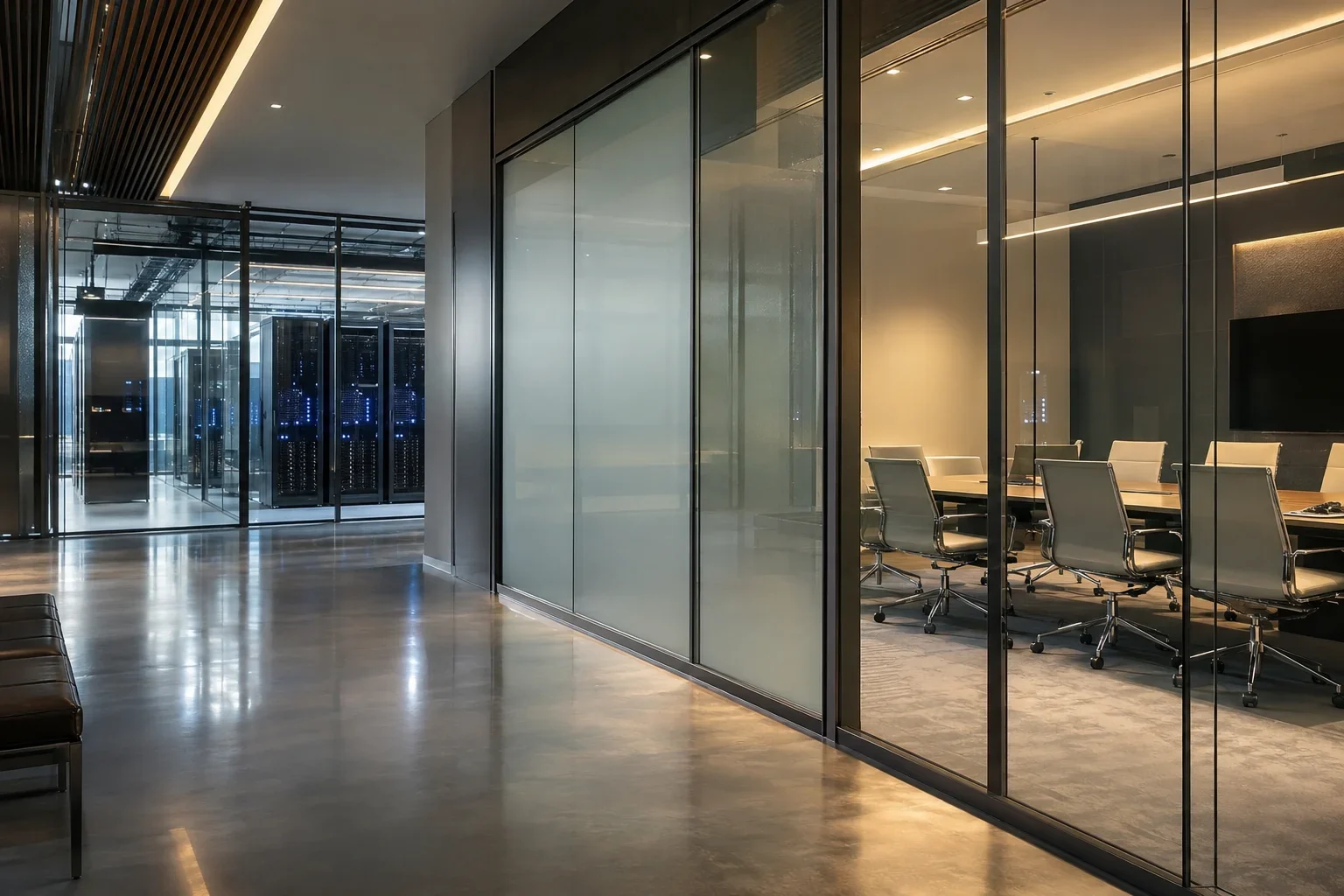
Visual Privacy Without Permanently Closing Off the Space
Data centers and secure facilities must balance competing architectural goals: operational visibility, controlled visitor access, confidential work, and an environment that does not feel unnecessarily enclosed. Glass supports openness and observation, but uninterrupted transparency is not appropriate everywhere. A visitor corridor might overlook sensitive displays, while a meeting room beside an operations floor may need privacy during an incident review.
A well-planned smart glass data center installation adds adjustable visual privacy to selected glazed areas. It allows teams to change a partition from transparent to frosted, or select a reverse configuration with a different unpowered state. The key is treating switchable glazing as part of the facility design—not as a standalone security system.
Smart Glass Technologies provides full turnkey installation, including laser templating, custom fabrication in Miami, certified installation crews, low-voltage wiring, busbar concealment, and automation integration. For architects and contractors, that coordinated scope is the main advantage: the visible finish and the systems behind it are planned together.
Where Smart Glass Fits in a Secure Facility
Operations and control rooms
Glazed control rooms can support supervision and a sense of connection across an operations floor. Switchable privacy is useful where adjacent circulation exposes dashboards, incident discussions, or confidential work. Plan each sightline carefully, including views through doors and sidelights. Privacy glazing should complement screen positioning and access policies rather than compensate for a poorly arranged room.
Visitor routes and demonstration spaces
Some facilities accommodate clients, auditors, or escorted visitors without giving them unrestricted views into operational areas. Smart glass can help define what is visible along those routes. An authorized host might reveal a designated observation area while keeping adjacent rooms private. The design should avoid assuming that a change in glass appearance also changes access permissions.
Briefing rooms and secure offices
Conference rooms near operations areas often alternate between routine collaboration and confidential discussions. Switchable partitions preserve a glazed architectural language while providing on-demand visual separation. They do not establish speech privacy, however. Door seals, wall construction, ceiling interfaces, and the acoustic performance of the complete assembly remain separate design considerations.
Support spaces outside critical zones
Smart glazing may also suit executive offices, training rooms, and staff areas within a secure campus. These locations can offer practical applications without introducing changes inside highly restricted operating environments. Review the available smart glass formats against the project's doors, windows, partitions, and room dividers before defining the scope.
Choose the Technology Around the Required Privacy State
Start with a simple operational question: what should this glazed opening look like when power to the switchable product is off? The answer affects product selection and the control sequence. Standard and reverse products behave differently, and neither default state is universally correct for every secure room.
| Product | Technology and unpowered state | Typical planning use | Published product pricing |
|---|---|---|---|
| PriWatt™ Smart Film | PDLC; frosted when off | Retrofit self-adhesive film for suitable existing glazing | $70/sq ft, plus $30/sq ft installation |
| PriWatt™ Reverse Smart Film | PNLC; clear when off | Retrofit applications requiring a clear unpowered state | $120/sq ft; installation scope confirmed by quote |
| PriWatt™ Smart Glass | PDLC; frosted when off | Laminated glass or IGU applications in new or replacement glazing | $145/sq ft, plus $50–$100/sq ft glass installation |
| PriWatt™ Reverse Smart Glass | PNLC; clear when off | New or replacement glazing requiring a clear unpowered state | $185/sq ft, plus $50–$100/sq ft glass installation |
Frosted glass is not a blackout barrier. Perceived privacy depends on lighting, viewing angle, proximity, and the relationship between the glazing and objects behind it. A secure-facility review should evaluate representative conditions, especially where people or displays sit close to the partition. Read more about how smart glass works before setting appearance expectations.
Electrochromic and SPD technologies address different light-control objectives and should not be assumed to provide the same privacy behavior as these PDLC and PNLC products. If the primary problem is solar glare rather than interior sightlines, establish that requirement separately before choosing a technology.
Keep Visual Privacy Separate From Security Performance
Smart glass can help manage direct views, but switchability alone does not establish forced-entry resistance, ballistic protection, fire resistance, electromagnetic shielding, or acoustic isolation. Where a facility requires any of those properties, the design team must specify and verify the appropriate complete assembly independently.
Smart Glass Technologies is UL and SGCC certified. Project submittals should still confirm the applicability of certifications to the proposed product and assembly. Do not treat those certifications as evidence that switchable glazing satisfies a facility's broader security or fire-protection requirements.
Likewise, a frosted state should not be described as a guaranteed protection against photography or observation. Sensitive information still needs appropriate screen layouts, visitor management, and physical access controls. Security personnel should review the proposed application alongside the architect and facility operator.
Plan Power, Controls, and Operating Procedures Together
Define normal and unpowered conditions
Document the intended state during routine occupancy, visitor tours, confidential meetings, and loss of power to the glazing system. PDLC products are frosted when off; reverse PNLC products are clear when off. Whether either behavior is desirable depends on the room. A privacy objective may favor frosting, while an observation requirement may favor transparency.
Do not label a product broadly as fail-safe or fail-secure without explaining the specific function being evaluated. The glazing's optical state does not determine door locking, emergency access, or evacuation requirements. Those systems need their own coordinated design and approval.
Set control permissions
Decide who can change each privacy zone and where controls should be located. A local wall control may suit a meeting room, while a visitor-facing partition may need an authorized operator. Smart Glass Technologies supports integration with Lutron, Crestron, and Control4. Any proposed connection to facility systems should be reviewed against the site's controls architecture and cybersecurity policies.
Preserve maintenance access
Identify accessible locations for power and control components, along with concealed cable routes and serviceable terminations. Maintenance should not require unnecessary access to restricted operational areas. Agree on documentation, labeling, and functional checks before installation so the facilities team understands how each zone operates.
Why Turnkey Installation Matters More Than Film Alone
In secure facilities, coordination failures can matter as much as product selection. Exposed wiring, inaccessible components, inconsistent privacy zones, or poorly planned installation access can create avoidable rework. Smart Glass Technologies is not a DIY kit seller; its turnkey service addresses the complete installation scope.
The process includes laser templating to capture glazing geometry, custom fabrication in Miami, and installation by certified crews. Low-voltage wiring and busbar concealment are coordinated with the architectural finish, while automation integration is planned around the agreed operating sequence. That approach gives the project team a defined partner for the switchable-glazing work rather than leaving key interfaces unresolved.
Headquartered and manufacturing in Miami, Florida, Smart Glass Technologies was founded in 2018. Its PriWatt products are made in the USA, with 200,000+ sq ft installed and local installers across 26+ US metros. Confirm availability through the service-area checker, particularly when site access or construction phasing requires careful scheduling.
For occupied facilities, agree in advance on work-area separation, escort requirements, permitted installation windows, and protection of adjacent operations. These are project-specific responsibilities that should be coordinated with the general contractor and facility management team before crews arrive.
Budget for the Finished, Operable Installation
Published product pricing provides a useful starting point, but procurement should compare clearly defined scopes. Confirm whether the proposal covers the selected glazing or film, installation, wiring, concealment, controls integration, and any required coordination with other trades. Existing-glass suitability and replacement-glazing requirements should be resolved before finalizing the approach.
Use the smart glass cost guide to review the available products, then request a project-specific quote. Warranty coverage is 3 years for PriWatt Glass, 2 years for PriWatt Film, and 1 year for installation. Written terms accompany every quote; review the warranty information alongside the proposed scope and maintenance expectations.
Practical Buyer Checklist
- Map sensitive sightlines: Identify views from visitor corridors, adjacent rooms, doors, and observation areas.
- Define the privacy objective: Separate visual screening from acoustic, physical-security, and fire-protection requirements.
- Select the unpowered state: Confirm whether each zone should be frosted or clear when power is off.
- Review realistic viewing conditions: Evaluate lighting, object proximity, and display placement with the security team.
- Choose retrofit or replacement: Have existing glazing assessed before specifying self-adhesive film.
- Coordinate controls: Document permissions, local operation, automation interfaces, and site approval requirements.
- Plan installation access: Establish escort procedures, work windows, cable routing, and component access.
- Confirm handover requirements: Request operating documentation, functional checks, and written warranty terms.
Specify Privacy as a Coordinated Architectural System
The strongest smart glass data center projects begin with a clear privacy objective and a realistic understanding of what switchable glazing can—and cannot—do. Coordinating the glass, wiring, controls, and installation helps create a polished result that supports facility operations without overstating security performance.
Bring your plans, sightline concerns, and operating requirements to Smart Glass Technologies. Request pricing for a turnkey smart glass installation.
Frequently Asked Questions
Does smart glass make a data center partition security-rated?
No. Switchable glazing manages visual privacy; it does not by itself establish forced-entry resistance, ballistic protection, fire resistance, electromagnetic shielding, or acoustic isolation. Any required security performance must be specified and verified for the complete assembly.
What happens to smart glass when power is off?
PriWatt Smart Film and PriWatt Smart Glass use PDLC technology and are frosted when off. PriWatt Reverse Smart Film and PriWatt Reverse Smart Glass use PNLC technology and are clear when off. Select the unpowered state according to each room's privacy and observation requirements.
Can smart film be added to existing control-room windows?
PriWatt Smart Film is a retrofit self-adhesive product for suitable existing glazing. The glass condition, installation access, wiring routes, and required privacy performance should be assessed before confirming the application.
What does Smart Glass Technologies handle during installation?
Smart Glass Technologies provides turnkey service covering laser templating, custom fabrication in Miami, certified installation crews, low-voltage wiring, busbar concealment, and automation integration with Lutron, Crestron, and Control4. The project quote defines the agreed scope.