
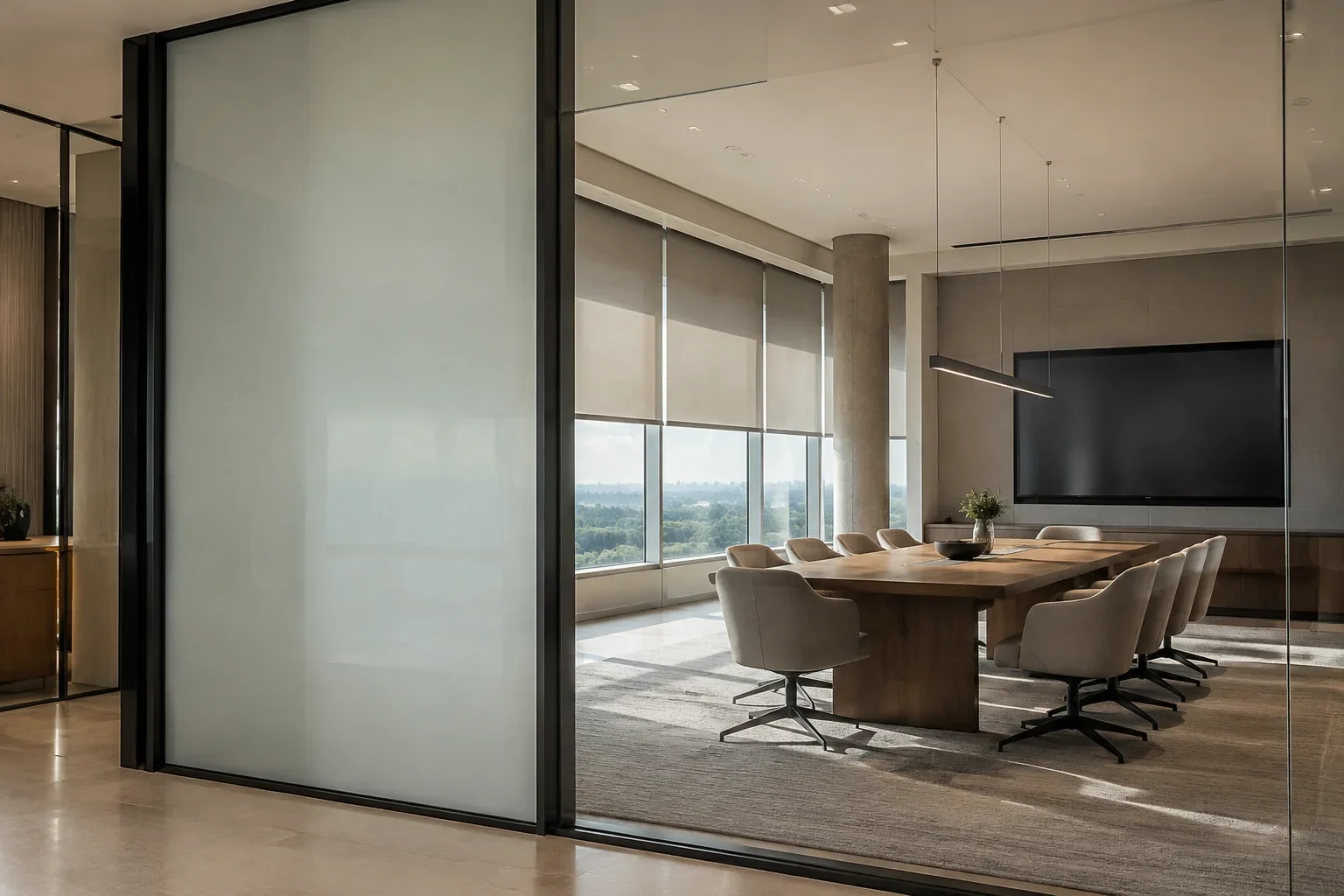
A conference room needs to feel open when collaboration is welcome and private when the conversation turns sensitive. It also needs comfortable daylight, readable screens and controls that work without interrupting a meeting. Both smart glass and motorized blinds can contribute, but they do not deliver the same results.
The smart glass vs blinds decision starts with identifying the actual problem: visual privacy across an interior partition, glare from exterior windows, or both. For architects, commercial general contractors, interior designers and owners, the best solution also depends on installation coordination and how the finished room will operate.
Smart Glass Technologies provides a full turnkey service, not a DIY kit. Laser templating, custom fabrication in Miami, certified installation crews, low-voltage wiring, busbar concealment and automation integration are coordinated as part of the finished installation.
Smart Glass vs Blinds: The Core Difference
Motorized blinds place a movable covering in front of the glazing. Depending on the selected material and configuration, they can reduce glare, provide privacy or darken a room. Their appearance changes as shades lower, raise or adjust, and the assembly needs space for mounting, movement and service.
Smart glass changes the optical state of the glazing itself. PriWatt™ Smart Film and PriWatt Smart Glass use PDLC technology to switch between a clear state and a frosted privacy state. Standard PDLC products are frosted when off. Reverse PriWatt products use PNLC technology and are clear when off.
Privacy glazing should not be confused with blackout shading or solar-control tinting. A frosted state diffuses light rather than functioning like an opaque blackout covering. For background on the technology, see how smart glass works.
| Decision factor | PriWatt privacy glazing | Motorized blinds |
|---|---|---|
| Interior visual privacy | Changes the glazing state without a separate covering | Uses a shade or slat assembly to cover sightlines |
| Daylight and glare | Diffuses light in the privacy state; not a blackout substitute | Can be specified with fabrics or materials suited to glare reduction and darkening |
| Architectural appearance | Maintains a glass-first design without hanging fabric or slats | Adds visible covering materials and mounting hardware |
| Installation scope | Requires glazing assessment, electrical coordination and finished-edge planning | Requires mounting support, clearance, power planning and control coordination |
| Maintenance considerations | Surface care, electrical components and accessible service points | Fabric or slat cleaning, moving hardware and motor access |
| Power-off behavior | Standard PriWatt is frosted; reverse PriWatt is clear | Depends on the selected drive and control system |
Which Option Provides Better Conference-Room Privacy?
Interior glass partitions
Smart glass is particularly well suited to conference rooms facing corridors, reception areas or open-plan offices. It lets a transparent enclosure become visually private without lowering a separate covering. When privacy is no longer needed, the room can return to an open appearance.
Motorized blinds can also provide effective visual screening. However, privacy depends on the covering material, panel layout and gaps at the edges. At doors, corners and adjoining panels, detailing matters as much as the nominal shade specification.
Privacy is not the same as complete concealment
With frosted privacy glazing, silhouettes or nearby objects may remain perceptible under some lighting conditions. Evaluate a sample with the expected viewing distance, lighting contrast and furniture placement. Sensitive meeting environments should be reviewed for their actual sightlines rather than relying on a product photograph.
Neither switching glass nor lowering a blind establishes acoustic confidentiality. Sound isolation depends on the entire room enclosure, including glass construction, doors, seals, ceilings and mechanical paths. Address visual privacy and acoustic privacy as separate design requirements.
Glare, Daylight and Video Meetings
Exterior-facing conference rooms present a different challenge from interior partitions. Direct sun can make a display difficult to read, create backlighting on video calls and affect comfort at the meeting table. Motorized shading can be a strong choice when controlling incoming sunlight is the primary goal.
PDLC privacy glazing scatters transmitted light in its frosted state. That can change the room’s lighting appearance, but it should not be specified as a guaranteed solution for solar heat gain, screen glare or room darkening. Electrochromic and SPD technologies address light modulation differently and require their own project-specific evaluation.
Often, the strongest design combines technologies: smart glass on corridor-facing walls for visual privacy and motorized shades on exterior windows for daylight management. Coordinate both with the audiovisual consultant so privacy scenes, presentation scenes and video-call lighting support one another.
Design Impact and Everyday Maintenance
In a glass-forward workplace, switchable privacy can preserve the intended architectural language. There are no shade fabrics or slats hanging across the partition. This can be especially useful where the design relies on continuous glazing, carefully aligned doorways or unobstructed views between meeting spaces.
Blinds offer their own design advantages. Fabrics, colors and textures can soften a room and complement the interior palette. Their housings and side details should be intentionally integrated rather than added after the ceiling and glazing are complete.
Neither approach is maintenance-free. Blinds have moving assemblies and materials that need appropriate cleaning. Smart film requires product-appropriate surface care, while the switching system needs accessible electrical service points. Agree on cleaning procedures and maintenance access before handover, especially where facilities teams use standardized cleaning routines.
Retrofit Film or New Smart Glass?
Retain suitable existing glazing with smart film
PriWatt Smart Film is a self-adhesive retrofit product for suitable existing glass. It can be worth considering when a conference-room enclosure is already installed and the goal is to add switchable privacy without replacing the glazing.
Suitability should be assessed before ordering. Glass condition, panel geometry, door operation, edge exposure and wiring routes all affect the installation plan. A retrofit still requires precise measurement and professional finishing; it is not simply a film purchase.
Coordinate laminated glass or an IGU with new construction
PriWatt Smart Glass is available as PDLC laminated glass or an insulated glass unit. For new conference rooms or substantial renovations, incorporating smart glass into the glazing package allows the team to coordinate framing, door hardware, electrical routing and installation sequencing together.
Doors and fixed partitions need different coordination, particularly where wiring must accommodate movement. Review available smart glass formats early enough to align the privacy system with the architectural details.
Compare Complete Installed Costs
A useful cost comparison includes more than the glass, film or shade material. For motorized blinds, obtain a project-specific proposal covering the covering material, motors, housings, mounting work, wiring, controls and commissioning. For smart glass, compare the selected product and installation scope against the same project requirements.
| PriWatt product | Product price | Installation pricing |
|---|---|---|
| Smart Film, PDLC | $70/sq ft | $30/sq ft |
| Reverse Smart Film, PNLC | $120/sq ft | Confirm in the project quote |
| Smart Glass, PDLC laminated glass / IGU | $145/sq ft | $50–$100/sq ft |
| Reverse Smart Glass, PNLC | $185/sq ft | $50–$100/sq ft |
Ask each bidder to identify what is included and what remains in another trade’s scope. Site conditions, electrical coordination, framing requirements and automation work should be clear before comparing proposals. Use the smart glass cost guide as a starting point, then request pricing for the actual room.
Why Turnkey Installation Matters
The difference between a compelling sample and a polished conference room is execution. Visible wiring, poorly coordinated door details or inaccessible components can undermine an otherwise strong design. Smart Glass Technologies takes responsibility for the coordinated installation process rather than leaving the buyer to assemble a DIY solution.
The service includes laser templating, custom fabrication in Miami, certified installation crews, low-voltage wiring, busbar concealment and integration with Lutron, Crestron or Control4. Control behavior should be defined during planning, including the desired power-off state and how users activate privacy during meetings.
Headquartered and manufacturing in Miami, Florida, Smart Glass Technologies offers Made in the USA products and local installers across 26+ US metros. The company has installed 200,000+ sq ft. Check your service area before establishing the project schedule.
Warranty responsibilities are also explicit: PriWatt Glass carries a 3-year warranty, PriWatt Film a 2-year warranty and installation a 1-year warranty. Written terms accompany every quote; review the warranty information alongside the proposed scope.
A Practical Buyer Checklist
- Define the priority: interior visual privacy, solar glare, presentation darkening or a combination.
- Review real sightlines: assess seated occupants, corridor views, doors and adjoining panels.
- Test the lighting conditions: evaluate samples with expected daylight, interior lighting and screen placement.
- Select the power-off state: decide whether frosted-off or clear-off behavior fits the room’s operation.
- Coordinate construction: confirm glazing suitability, mounting conditions, wiring paths and service access.
- Plan the controls: define wall controls and automation scenes with the electrical and audiovisual teams.
- Compare complete scopes: include installation, electrical work, finishing, commissioning and warranty responsibilities.
- Set maintenance expectations: document approved cleaning methods and the service contact.
Choose for the Room, Not Just the Product
For interior conference-room privacy and a clean glass aesthetic, smart glass is a compelling choice. For exterior-window glare management or room darkening, motorized blinds may be the better tool. Some rooms benefit from both. The right specification matches each technology to a clearly defined task and assigns responsibility for delivering the finished system.
Bring your plans to Smart Glass Technologies for a coordinated turnkey solution. Request conference-room pricing.
Frequently Asked Questions
Is smart glass better than motorized blinds for conference rooms?
Smart glass is particularly useful for visual privacy on interior glass partitions while preserving a glass-first design. Motorized blinds can be better suited to exterior-window glare control and room darkening. Some conference rooms benefit from using both.
Does frosted smart glass block all light and silhouettes?
No. Frosted privacy glazing diffuses light rather than acting as a blackout covering. Silhouettes or nearby objects may remain perceptible depending on lighting and viewing distance, so evaluate samples under conditions that reflect the room.
Can smart film be installed on existing conference-room glass?
PriWatt Smart Film is a self-adhesive retrofit option for suitable existing glass. Smart Glass Technologies assesses the glazing, panel geometry, door operation and wiring routes before coordinating fabrication and installation.
Can conference-room smart glass work with automation systems?
Smart Glass Technologies provides automation integration with Lutron, Crestron and Control4 as part of its turnkey service. Define the desired control scenes, user operation and power-off behavior during project planning.
What happens to smart glass when power is off?
Standard PriWatt Smart Film and Smart Glass use PDLC technology and are frosted when off. Reverse PriWatt products use PNLC technology and are clear when off. Choose the behavior that fits the room’s operational requirements.