
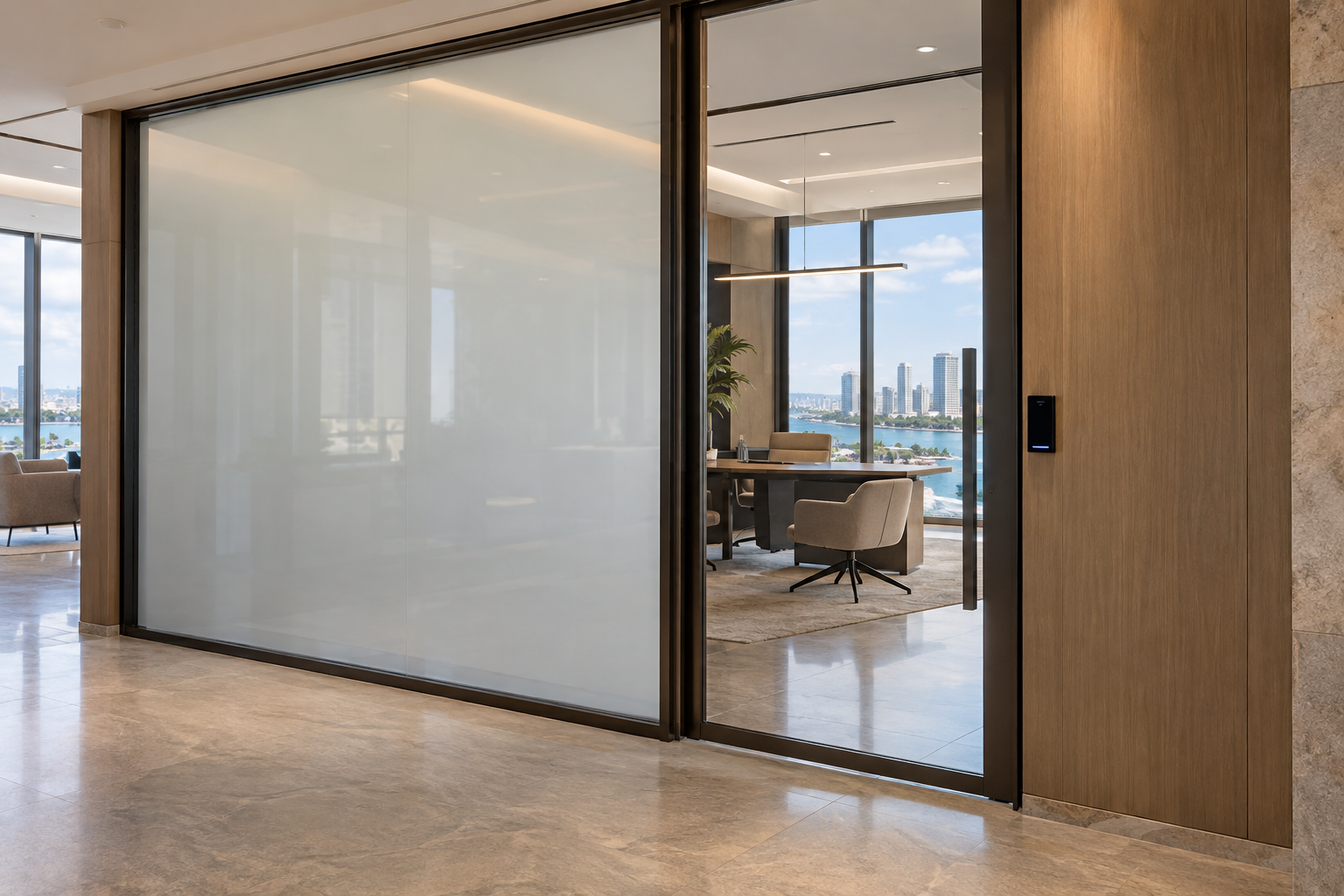
Smart glass with smart access control brings two different building functions into a more intentional experience: deciding who may enter a space and deciding when people can see into it. In an executive office, a credential could initiate an approved arrival scene. In a luxury residence, a privacy setting could coordinate with lighting and a controlled entry. The goal is not simply more automation; it is behavior that occupants understand and trust.
The distinction matters: switchable glass controls visibility, while access-control hardware manages entry permissions and locking. Smart Glass Technologies (Smart Glass Tech US) helps project teams plan the glass side through a full turnkey service, including laser templating, custom fabrication in Miami, certified installation crews, low-voltage wiring, busbar concealment, and automation integration. That coordination is the primary advantage over purchasing a film or glass panel and leaving the details to separate trades.
How Smart Glass and Access Control Work Together
A typical coordinated design includes switchable glass or film, its compatible power and control equipment, an access-control system, and an automation interface where needed. The access system handles credentials and door permissions. The glass controller changes the glazing's visual state. A properly designed interface allows selected events to trigger an approved privacy response without confusing these separate responsibilities.
Compatibility should never be assumed. The project team must confirm which signals are available, how the controllers communicate, and which contractor owns each connection. An access event might be passed through a building automation platform, for example, rather than connected directly to the glazing equipment. Smart Glass Tech US provides automation integration with Lutron, Crestron, and Control4; access-control compatibility and the required interface must be evaluated for each project.
For an introduction to the glazing itself, review how smart glass works. For an integrated entry, the most important additional document is a written sequence of operations describing what the glass should do during arrival, occupancy, departure, and abnormal conditions.
Keep Visual Privacy Separate from Physical Security
Frosted glass is not a locked door, and clear glass does not mean entry is authorized. Switching the glass should not independently grant access or replace security hardware. Likewise, a privacy button inside a room should not unexpectedly change door permissions. These boundaries help prevent an appealing automation feature from becoming an operational problem.
Smart film should not be treated as a substitute for security-rated glazing. Glass composition, impact requirements, door hardware, and any security performance must be specified separately. Visual privacy also does not establish acoustic confidentiality; a private meeting room still requires appropriate wall, door, and perimeter detailing.
The design team and relevant specialists must coordinate required egress, accessibility, and life-safety behavior. Do not use the glass's power state to infer the lock's behavior during an outage. Lock operation and glazing appearance are separate decisions, each needing its own documented response.
Choose the Right PriWatt™ Product and Default State
The right product depends on whether the project retains existing glazing or installs new glass, along with the preferred appearance when glass power is off. PriWatt™ offers standard PDLC and reverse PNLC options. Their different default states are especially important when privacy is tied to occupancy or entry events.
| Product | Typical application | Power-off appearance | Published product pricing |
|---|---|---|---|
| PriWatt Smart Film | Self-adhesive PDLC retrofit for suitable existing glass | Frosted | $70/sq ft plus $30/sq ft installation |
| PriWatt Reverse Smart Film | PNLC film where a clear default is preferred | Clear | $120/sq ft |
| PriWatt Smart Glass | PDLC laminated glass or IGU for new or replacement glazing | Frosted | $145/sq ft |
| PriWatt Reverse Smart Glass | PNLC glass where a clear default is preferred | Clear | $185/sq ft |
Glass installation is $50–$100/sq ft. Confirm the complete installation scope for reverse film and all project-specific control work in the written quote. Published product pricing is not a complete access-control system budget. Readers, locks, interfaces, programming, and related work should be clearly assigned and priced within the appropriate trade scopes. See the smart glass cost guide for pricing context.
Neither default state is universally better. A consultation room may favor frosted glazing when power is off, while another space may prioritize visibility. Frosted privacy is also not blackout: lighting, viewing conditions, and proximity can affect perceived silhouettes. Review samples under representative conditions before finalizing a sensitive application.
Design Useful Scenes Instead of Automatic Surprises
Executive offices and meeting rooms
A credentialed entry can initiate an arrival scene, but it should not automatically make an occupied room transparent. A better sequence may allow entry while preserving an active privacy setting. The occupant can then choose a meeting scene that coordinates the glazing and lighting through an approved control platform.
Departure needs similar care. A door opening does not prove the room is empty, and a calendar ending does not prove a meeting has finished. Occupancy information, a manual release, or another agreed condition may be needed before the system restores the normal appearance.
Consultation and client-facing spaces
In consultation rooms, private offices, and premium client suites, glass can maintain an open architectural character between appointments while supporting privacy during use. An access event can support the workflow, but the privacy sequence should protect the people already inside. Staff need a straightforward local control rather than a process that depends entirely on an app.
Luxury residential entries and private suites
For residences, coordinated scenes can connect entry permissions, lighting, and privacy at glazed doors or interior room dividers. Guest access should not necessarily override a homeowner's privacy setting. Define which users may operate the glass, what a guest credential can trigger, and how the owner can restore local control.
Resolve the Architectural and Electrical Details Early
The glass may be visually minimal, but its electrical connections still need a planned route. Architects and interior designers should coordinate framing, busbar concealment, finish transitions, and service access before shop drawings are approved. A beautiful elevation can be compromised by exposed wiring or a late-added control enclosure.
Moving doors require particular attention. The team must coordinate a suitable wiring approach with the door and hardware design, rather than adapting a fixed-panel detail on site. Existing glass also needs evaluation before specifying retrofit film. Condition, geometry, surrounding materials, and exposure all affect whether the proposed installation is appropriate.
Available applications include doors, office partitions, room dividers, windows, and other architectural configurations. Explore smart glass formats while the layout is still flexible. Select the format and control approach together so that the intended daily use informs the physical detailing.
Why Turnkey Installation Matters More Than a Component List
Integrated privacy projects often fail at the boundaries between trades: the glazing is ready, but the cable route is missing; the automation is programmed, but the glass default is wrong; the access vendor expects a connection nobody included. A coordinated turnkey glass scope reduces these gaps by connecting measurement, fabrication, electrical detailing, installation, and automation planning.
Smart Glass Tech US is not a DIY kit seller. Its service includes laser templating, custom fabrication in Miami, certified install crews, low-voltage wiring, busbar concealment, and automation integration. The access-control contractor and other project specialists still need clearly defined responsibilities, but the glass package is not left as an unsupported component for someone else to resolve.
Headquartered and manufacturing in Miami, Florida, the company was founded in 2018, provides Made in the USA products, and has installed 200,000+ sq ft. Local installers serve 26+ US metros. UL and SGCC certifications should be reviewed against the selected assembly and project submittal requirements, rather than assumed to certify an entire integrated security system. Check the service area early in planning.
A Practical Buyer Checklist
- Define the privacy goal: Identify who needs visual privacy, under what conditions, and whether silhouettes are acceptable.
- Select the default appearance: Document the required glass state when its power is off.
- Separate permissions: Decide who may unlock the door, operate privacy, and change automation settings.
- Write the sequence: Cover arrival, occupied-room entry, departure, manual override, and power restoration.
- Confirm interfaces: Require the access-control and automation teams to verify compatibility before procurement.
- Assign trade scope: Identify responsibility for controllers, wiring pathways, interfaces, programming, and final testing.
- Review installation details: Approve busbar locations, concealed wiring, moving-door connections, and service access.
- Check the quote: Distinguish product and installation costs from access hardware and project-specific integration.
- Plan the handover: Request operating instructions, approved settings, warranty terms, and a clear service contact.
Commission the Experience Before Handover
Testing should follow the actual sequence of operations, not just demonstrate that the glass switches. Verify that an authorized entry produces the intended response, an unauthorized attempt does not reveal the room, and an active privacy setting behaves correctly when another authorized person arrives. Confirm local override behavior and recovery after a loss of power or communications.
Provide facilities staff or homeowners with a clear explanation of normal operation and fallback controls. PriWatt Glass carries a 3-year warranty, PriWatt Film a 2-year warranty, and installation a 1-year warranty, with written terms supplied with every quote. Review the warranty information alongside the separate terms for access hardware and automation equipment.
Ready to coordinate privacy with controlled entry? Request pricing from Smart Glass Tech US for a turnkey smart glass scope tailored to your space, controls, and installation requirements.
Frequently Asked Questions
Can smart glass connect to an existing access-control system?
Potentially, but compatibility must be verified. The access-control contractor and automation team need to confirm available signals, the required interface, and the approved sequence of operations. Smart Glass Tech US provides automation integration with Lutron, Crestron, and Control4.
Does smart glass secure or unlock a door?
No. Smart glass manages visibility, while locks, readers, and access-control equipment manage entry. An integrated design can coordinate their behavior, but switching the glass should not independently grant access.
What happens to privacy glass during a power outage?
PriWatt Smart Film and PriWatt Smart Glass are frosted when glass power is off. PriWatt Reverse Smart Film and PriWatt Reverse Smart Glass are clear when power is off. Door-lock behavior must be specified separately.
Should a credential automatically make smart glass clear?
Not necessarily. An authorized arrival should not expose an occupied private room. The sequence can preserve an existing privacy setting and allow an occupant to change it through an approved local control.
Why choose turnkey installation for an integrated smart glass project?
Turnkey service coordinates glass measurement, fabrication, installation, concealed electrical connections, and automation planning. Smart Glass Tech US provides these services while working with project specialists to define access-control interfaces and trade responsibilities.