
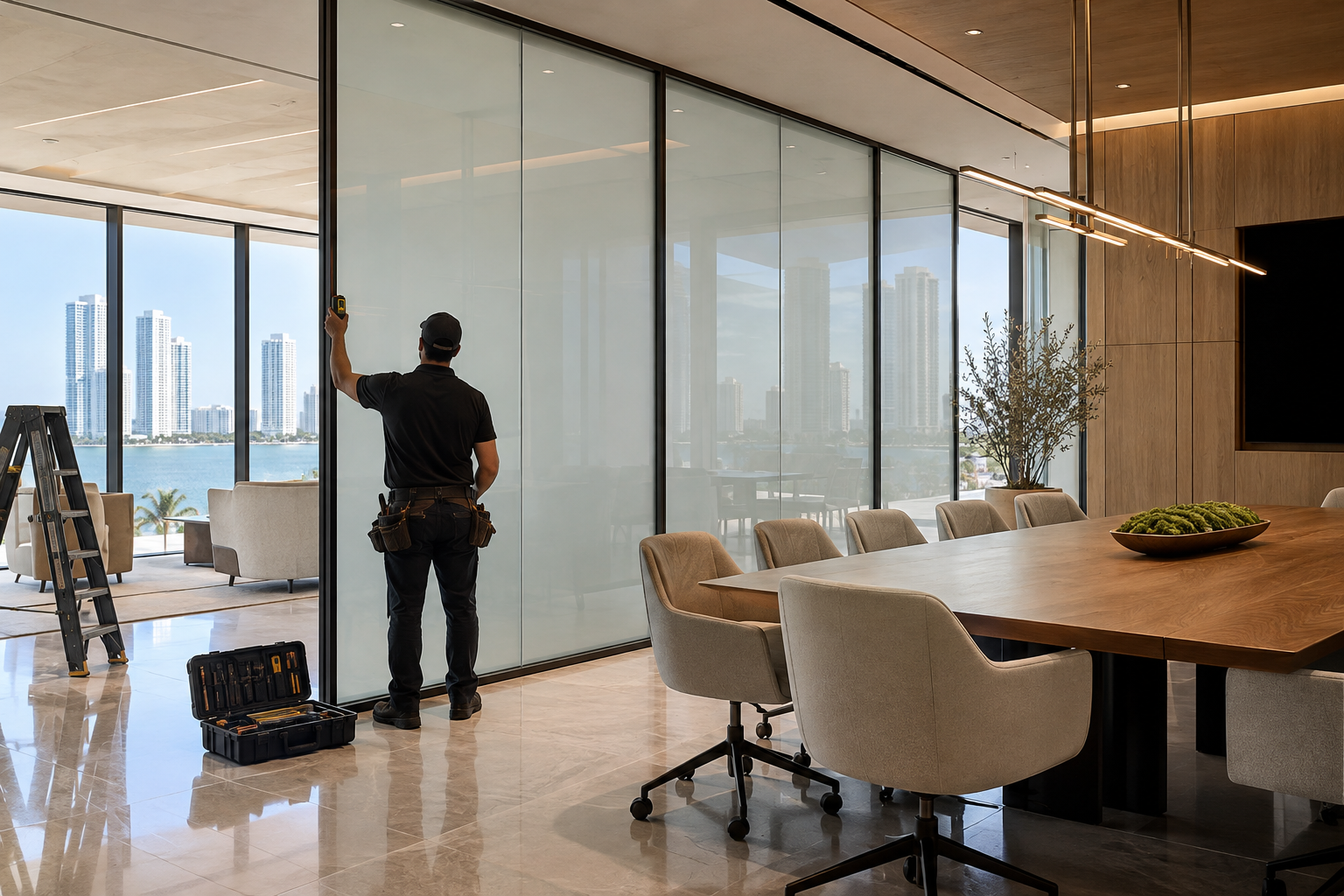
A smart glass project timeline is not simply the gap between placing an order and receiving glass. It includes defining the scope, checking existing conditions, approving technical details, fabricating the product, preparing electrical connections, and coordinating installation. A retrofit office partition and a custom laminated-glass shower enclosure follow different paths, even when both deliver switchable privacy.
The most useful answer to “How long will it take?” is a project-specific schedule tied to clear milestones—not a universal lead-time promise. Smart Glass Technologies (Smart Glass Tech US) provides full turnkey installation, including laser templating, custom fabrication in Miami, certified installation crews, low-voltage wiring, busbar concealment, and automation integration. That coordinated scope helps prevent gaps between product delivery and a functioning installation.
What Determines Your Smart Glass Project Timeline?
The main variables are the chosen product, the condition of the opening or existing glass, approval requirements, and site access. Design complexity matters, too. Curved glass, moving doors, concealed wiring, and connections to building controls require different coordination than a straightforward fixed partition.
Before committing to a completion date, distinguish between product readiness and installation readiness. Fabrication may be complete while frames, electrical provisions, or adjacent finishes are still unfinished. Conversely, the site may be ready while a design change is holding up production approval.
Ask for a schedule that identifies what starts each stage, who must approve it, and which conditions could change the installation date. A reliable plan makes those dependencies visible rather than treating every project as a standard shipment.
From Initial Inquiry to an Installation-Ready Scope
Share the intended use and project conditions
The quoting process starts with understanding what the glass needs to do. Is it providing privacy for a conference room, separating a bedroom and bath, or replacing window coverings in a residential space? Share photographs, drawings, approximate dimensions, the project location, and whether the work involves existing glass or new construction.
State your desired completion date early, especially if it is linked to occupancy, a renovation handover, or business operations. That date becomes a planning target to evaluate—not a guarantee before technical review. You can also check service availability before aligning the installation with your broader construction schedule.
Select film or glass before finalizing the schedule
PriWatt™ Smart Film is a self-adhesive PDLC retrofit product that is frosted when off. Where existing glass is suitable, it can avoid the replacement-glass scope. Suitability still needs review: glass condition, edge access, wiring routes, and environmental exposure all affect the proposed installation.
PriWatt Smart Glass is PDLC laminated glass or an insulated glass unit. It belongs in the glazing scope and requires coordination with the opening, framing, handling, and installation sequence. PriWatt Reverse Smart Film and PriWatt Reverse Smart Glass use PNLC technology and are clear when off. Confirming the desired default state early helps avoid changes after the design has advanced.
For background on the switching behavior, visit how smart glass works. Product selection should reflect how the space will be used, not only which option appears simplest to schedule.
How Different Project Types Affect Scheduling
| Project type | Main planning dependency | Schedule consideration |
|---|---|---|
| PriWatt Smart Film on existing glass | Confirmation that the glass and surrounding conditions suit the retrofit | Avoids replacement glazing when suitable, but still requires surface preparation, wiring, and coordinated access |
| PriWatt Smart Glass in new framing | Approved glazing details and verified opening conditions | Fabrication and installation must align with framing, electrical work, and adjacent finishes |
| PriWatt Reverse Film or Glass | Confirmation that clear-when-off behavior meets the design intent | Resolve product selection and control requirements before production approval |
| Doors, curved glass, or specialty formats | Detailed review of geometry, hardware, and cable routing | Allow for additional coordination rather than assuming a standard partition sequence |
| Automation-integrated installation | Agreed control scope and responsibilities | Coordinate control interfaces before closing walls or concealing wiring |
This comparison describes scheduling dependencies, not fixed lead times. Review the available smart glass formats while developing the scope so that specialty requirements are identified before the quote becomes a production plan.
Survey, Laser Templating, and Design Approval
Preliminary drawings help establish scope, but custom fabrication needs reliable project dimensions. Laser templating verifies geometry for the intended installation. The appropriate survey milestone depends on the project: existing glazing may be accessible immediately, while new openings may need further construction before measurements can be finalized.
For architects and general contractors, the key question is whether the measured conditions will remain unchanged. Changes to frames, finished surfaces, hardware, or opening geometry after measurement can trigger another review and potentially affect the schedule.
Design approval should also resolve visible details. Where will the electrical connection enter? How will the busbar—the conductive connection along the product edge—be concealed? Where will controls and associated components remain accessible? These decisions influence both appearance and installation sequencing.
A consolidated approval process helps. Have the owner, designer, contractor, and relevant electrical or controls teams review the same scope. Conflicting approvals can create delays even when each participant responds promptly.
Custom Fabrication and Parallel Site Preparation
Release an approved scope for fabrication
Once the required dimensions and technical details are approved, the project can move toward fabrication under the agreed order process. Smart Glass Tech US is headquartered in Miami, Florida, with manufacturing in Miami and products made in the USA.
Local manufacturing does not eliminate the need for a confirmed production schedule. Ask when the fabrication window can be confirmed, what approvals are required for release, and how changes after release will be handled. Do not assume that a quote date automatically starts production.
Prepare the site while the product is being made
Where the construction sequence allows, site preparation can proceed alongside fabrication. Confirm framing readiness, electrical provisions, cable pathways, access arrangements, and protection of adjacent finishes. Keeping these tasks aligned helps avoid having a completed product waiting for an unfinished room.
Smart glass still needs an electrical plan even when the visible result is minimal. The turnkey scope includes low-voltage wiring, but the project team should confirm responsibility for upstream power, any required electrical work, and associated approvals. Define those boundaries before closing walls or completing finish carpentry.
Automation integration with Lutron, Crestron, or Control4 should also be discussed early. Agree on the desired switching behavior and how it will be controlled. Late requests to change a local switching arrangement into an integrated control system may require additional coordination.
Installation, Testing, and Handover
Installation should be scheduled against actual readiness, not only an anticipated construction completion date. A retrofit film installation needs suitable glass surfaces and working conditions. A glass installation needs prepared openings, safe handling access, and coordination with the surrounding construction.
Occupied offices and finished homes introduce access constraints. Building management rules, elevator arrangements, furniture movement, and other trades working nearby can affect when the crew can work efficiently. Communicate those restrictions during planning rather than at arrival.
After installation, the system should be checked for switching operation, electrical connections, finish details, and the agreed control behavior. Where automation is included, coordinate the necessary controls participation so the project does not stop at manual operation while integration remains unresolved.
Handover should include operating and care guidance plus written warranty terms. PriWatt Glass carries a 3-year warranty, PriWatt Film a 2-year warranty, and installation a 1-year warranty. Written terms accompany every quote; review the warranty information when comparing scopes.
Buyer Checklist: Keep the Schedule Moving
- Provide a complete inquiry: Include location, photos, drawings, approximate dimensions, intended use, and target completion date.
- Confirm the product: Decide between retrofit film and replacement glass, including the desired off-state appearance.
- Identify the approval owner: Establish who can authorize dimensions, technical details, and final design decisions.
- Protect measured conditions: Flag changes to openings, framing, hardware, or finishes before they affect fabrication.
- Resolve electrical responsibilities: Confirm power provisions, low-voltage routing, component access, and any controls scope.
- Plan for installation access: Share building restrictions, occupied-space requirements, and coordination needs with other trades.
- Request milestone updates: Track approvals, fabrication readiness, site readiness, installation, and handover separately.
- Compare complete scopes: Review fabrication, installation, wiring, concealment, integration, and warranty—not just the product price.
Why Turnkey Delivery Matters More Than a Fast Shipping Promise
A shipped product is not a completed architectural installation. Smart Glass Tech US is not a DIY kit seller: its core offering connects laser templating, custom fabrication, certified installation crews, wiring, concealment, and automation integration. That continuity reduces the coordination burden on owners and project teams.
Founded in 2018, the company has installed 200,000+ sq ft and has local installers across 26+ US metros. For scheduling, the practical advantage is a coordinated scope that addresses the work between design intent and everyday operation—not simply a delivery date.
Review smart glass cost considerations alongside the schedule so budget decisions do not emerge after design approval. A clearly defined product, prepared site, and agreed installation scope provide a stronger basis for planning than a generic turnaround estimate.
Ready to build a project-specific schedule? Request pricing from Smart Glass Tech US with your drawings, location, and target completion date.
Frequently Asked Questions
Is there a standard smart glass project timeline?
There is no single timeline that fits every project. Product selection, verified dimensions, design approvals, fabrication, site readiness, and installation access all influence the schedule. Request a project-specific plan with clear milestones.
Is retrofit smart film faster to install than new smart glass?
Retrofit film can avoid replacement glazing when the existing glass is suitable. However, it still requires assessment, preparation, wiring, and installation coordination. The overall schedule depends on the conditions and scope rather than the product category alone.
What information should I send to get a useful schedule estimate?
Provide your project location, photographs, drawings, approximate dimensions, intended application, and target completion date. Explain whether you are retaining existing glass and whether you want automation integration.
What can delay a smart glass installation?
Common scheduling obstacles include unresolved product choices, changes after measurement, incomplete framing or electrical provisions, late automation requests, and restricted site access. Resolving these dependencies early helps keep the work coordinated.
Does Smart Glass Tech US handle installation and wiring?
Yes. Its turnkey service includes laser templating, custom fabrication in Miami, certified installation crews, low-voltage wiring, busbar concealment, and automation integration with Lutron, Crestron, and Control4. Confirm upstream electrical responsibilities and the exact scope in your quote.