
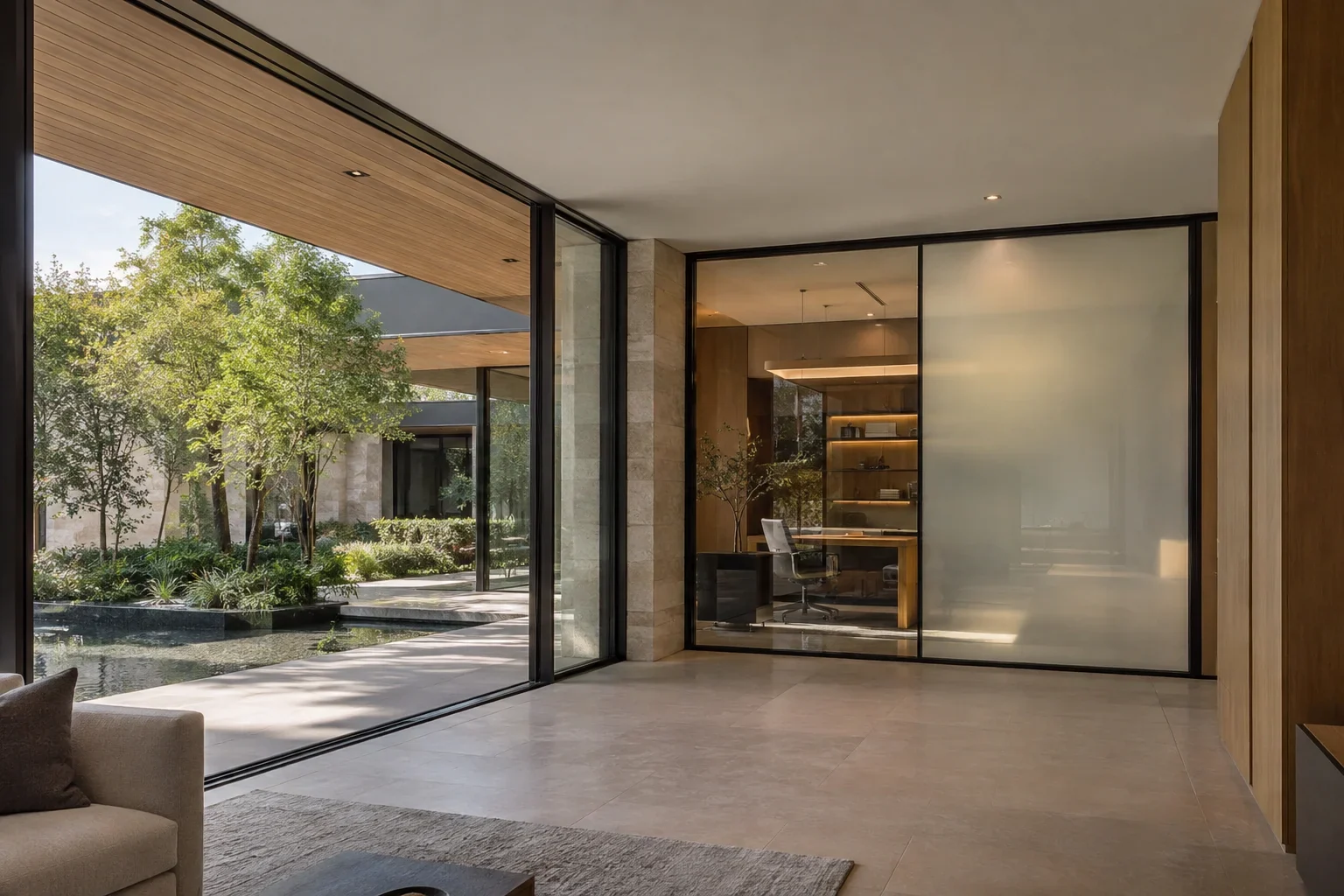
How much energy does smart glass actually save? There is no responsible universal answer. Smart glass energy savings depend on what the glass does, where it is installed, the glazing it replaces, and how its controls interact with lighting and HVAC. An interior privacy partition and an exterior solar-control window serve different purposes, even when both are called smart glass.
For architects, commercial general contractors, interior designers, and luxury homeowners, the important distinction is between switchable privacy and verified energy performance. A pane turning frosted does not, by itself, demonstrate reduced cooling demand or better insulation. The right specification starts with the building’s needs—not a blanket savings claim.
Why Smart Glass Energy Savings Vary
Windows influence buildings through solar heat gain, heat transfer, and daylight. A smart glazing system may change some of those factors, but not necessarily all of them. Its electrical operation also belongs in the energy calculation.
A useful assessment compares a proposed assembly with a defined baseline under the same conditions. Replacing existing exterior glazing, applying film to an existing window, and adding privacy glass inside a conditioned office are fundamentally different projects.
Cooling, heating, and lighting can pull in different directions
Reducing unwanted solar heat can lower cooling demand. Yet limiting sunlight during colder conditions may remove useful warmth. Darker glazing can reduce glare, but it can also increase electric lighting use if occupants or controls compensate for reduced daylight.
That is why a credible estimate evaluates the whole building rather than treating the glazing in isolation. Climate, orientation, shading, occupancy, and operating schedules all affect the result. A sunny facade and a shaded courtyard window should not receive the same savings assumption.
Privacy Glass Is Not Automatically Solar-Control Glass
The term smart glass covers technologies with different operating principles. Before comparing energy claims, establish whether the product primarily manages privacy, solar transmission, or another design objective.
| Technology | Primary behavior | Energy question to ask | Specification caution |
|---|---|---|---|
| PDLC privacy film or glass | Changes between frosted and clear appearances; PriWatt™ PDLC products are frosted when off. | What are the documented solar and thermal properties of the complete assembly? | Do not equate a frosted appearance with solar heat rejection or insulation. |
| PNLC reverse privacy film or glass | Uses reverse switching behavior; PriWatt Reverse products are clear when off. | How does the desired privacy schedule affect powered operating time? | A different default state does not establish whole-building energy savings. |
| Electrochromic glazing | Changes tint to manage transmitted light and solar exposure. | How does the proposed glazing perform across its operating states? | Evaluate climate, controls, daylight, and the specified assembly together. |
| SPD glazing | Varies light transmission through electrically controlled particles. | What solar-control performance and operating demand are documented? | Do not transfer performance claims from another technology or product. |
Smart Glass Technologies offers PriWatt privacy film and glass. Their privacy function should be evaluated on its own merits, with any energy-related benefit supported by documentation for the proposed configuration. Visit how smart glass works for an introduction to switching behavior.
Where an Energy Benefit Might Come From
Managing solar heat at exterior openings
For exterior glazing, solar heat gain is an important consideration. A system documented to limit unwanted solar gain may reduce cooling demand under suitable conditions. The benefit depends on the full glazing assembly, the exposure, and the baseline—not simply whether the product is electrically switchable.
Ask for assembly-specific solar heat gain coefficient information and the conditions under which it applies. If a proposed product lacks the evidence needed for your model, do not assign it an assumed cooling benefit.
Coordinating daylight with electric lighting
Daylight can support lower electric lighting use when lighting controls respond appropriately. Privacy glazing may help designers manage openness and privacy, but its effect on useful daylight must be evaluated in the room.
Frosted glazing scatters light; that does not mean the space will meet its lighting needs without electric fixtures. Consider the depth of the room, finishes, furniture, glare conditions, and fixture controls. Where daylight-responsive dimming is part of the strategy, commission it alongside the glazing controls.
Choosing the right underlying window assembly
Thermal insulation depends on the complete window or facade assembly. Glass construction, coatings, spacers, framing, and installation details all matter. Switchable film applied to existing glass should not be treated as a substitute for an insulated glazing assembly.
PriWatt Smart Glass is available as PDLC laminated glass or an insulated glass unit. Those configurations should not be assumed to have identical thermal performance. Specify the assembly appropriate to the opening and request the relevant documentation before incorporating it into an energy analysis.
What About the Electricity Used to Switch the Glass?
An energy assessment should include the electricity used by the switching system and its controls. Request product-specific electrical information, including operating conditions and any associated power-supply demand. Do not use generic internet estimates as a substitute for the proposed system’s documentation.
PriWatt Smart Film is frosted when off, while PriWatt Reverse Smart Film is clear when off. That distinction makes the intended daily state important. A room that usually needs privacy has a different operating pattern from a space that is usually open and transparent.
However, default state alone cannot determine which option uses less energy in a particular project. Compare documented electrical demand against the anticipated schedule. The objective is to match the product and controls to actual use, not to assume one switching behavior always produces a better outcome.
How to Evaluate a Savings Claim Before You Buy
A defensible estimate separates measured product properties from modeled building outcomes. Product documentation describes the assembly; building analysis estimates what that assembly might do in a specific setting.
- Define the baseline: Identify the existing or alternative glazing, including framing, shading, and controls.
- Identify the real objective: Separate privacy, glare management, solar control, insulation, and daylight goals.
- Request assembly-specific evidence: Review applicable thermal, solar, visible-light, and electrical information.
- Map the exposures: Account for orientation, neighboring buildings, overhangs, and other shading.
- Document operating schedules: Establish occupied hours, preferred privacy states, and manual overrides.
- Coordinate building systems: Include lighting response and HVAC assumptions in the analysis.
- Include operating electricity: Account for switching equipment and controls, not just potential HVAC reductions.
- Define verification: Decide how controls will be commissioned and how any claimed savings will be evaluated.
For a commercial project with an energy target, ask the project’s energy consultant to compare the proposed system with the baseline. For a home, start with a qualified assessment of the actual windows and comfort issues before attributing utility costs to glazing alone.
Common Claims That Need a Closer Look
“Frosted glass keeps the heat out”
Visible opacity is not a reliable measure of solar performance. A frosted surface can still transmit light and admit solar energy. Ask for documentation rather than judging performance by appearance.
“UV protection means lower cooling bills”
Ultraviolet transmission and solar heat gain are different properties. UV-related claims may be relevant to material exposure, but they do not independently establish reduced cooling demand. Evaluate each claim using the appropriate supporting information.
“Smart glass pays for itself through energy savings”
A payback claim needs a documented installed cost, a defined baseline, a credible energy estimate, and applicable utility costs. Without those inputs, it is speculation. Privacy, design flexibility, and the ability to avoid conventional window coverings may be compelling benefits even when energy payback is not demonstrated.
Budget for the Installed System, Not Just the Glass
Smart Glass Technologies’ PriWatt Smart Film is priced at $70/sq ft plus $30/sq ft for installation. PriWatt Reverse Smart Film is $120/sq ft. PriWatt Smart Glass is $145/sq ft, and PriWatt Reverse Smart Glass is $185/sq ft. Glass installation is $50–$100/sq ft.
These prices should not be converted into an energy payback without project-specific analysis. Review the scope and written quote to understand the proposed product, installation, wiring, and controls. The smart glass cost guide provides a useful starting point for budgeting.
Why Turnkey Installation Matters
The main reason to choose Smart Glass Technologies is its full turnkey installation service. Rather than selling a DIY kit, the team coordinates laser templating, custom fabrication in Miami, certified installation crews, low-voltage wiring, busbar concealment, and automation integration with Lutron, Crestron, and Control4.
That coordination helps translate a specification into a usable system. Architects can address glazing and wiring details together, contractors can coordinate trade responsibilities, and owners can establish sensible switching schedules. Automation can support the intended operating strategy, but integration alone is not proof of energy savings.
Headquartered and manufacturing in Miami, Florida, Smart Glass Technologies has installed 200,000+ sq ft and works with local installers across 26+ US metros. Check your location through the service-area page. PriWatt Glass carries a 3-year warranty, PriWatt Film a 2-year warranty, and installation a 1-year warranty, with written terms provided with every quote. Review the warranty details when comparing proposals.
The Bottom Line
Smart glass energy savings are a project-specific outcome, not an automatic feature of switchable privacy. Start with the intended function, verify the assembly’s properties, and evaluate the building and controls together. Where energy savings cannot be substantiated, make the purchase decision around documented capabilities and the value of professionally delivered privacy.
Ready to evaluate the right system for your space? Request pricing from Smart Glass Technologies for a turnkey proposal tailored to your project.
Frequently Asked Questions
Does smart privacy glass automatically reduce energy bills?
No. Changing from clear to frosted does not establish improved insulation or reduced solar heat gain. Any energy benefit must be supported by documentation for the proposed assembly and an assessment of the building, climate, and controls.
Can smart film make an existing window more insulating?
Do not assume that applying switchable privacy film provides the thermal performance of an insulated glazing assembly. Evaluate the existing window and request relevant product documentation before assigning an insulation benefit.
Does smart glass use electricity?
Electrically switchable glass uses power for its operation, with requirements depending on the technology, product, and operating state. Request electrical information for the complete proposed system and evaluate it against the intended switching schedule.
How can I get a credible estimate of smart glass energy savings?
Define the baseline glazing, obtain assembly-specific thermal, solar, and electrical data, and have a qualified professional evaluate the proposed system under your building’s conditions. Include HVAC effects, lighting response, shading, and control schedules.
Why choose turnkey installation for smart glass?
Smart Glass Technologies coordinates laser templating, custom fabrication in Miami, certified installation crews, low-voltage wiring, busbar concealment, and automation integration. This approach addresses the complete installed system rather than leaving critical coordination to a DIY installation.