
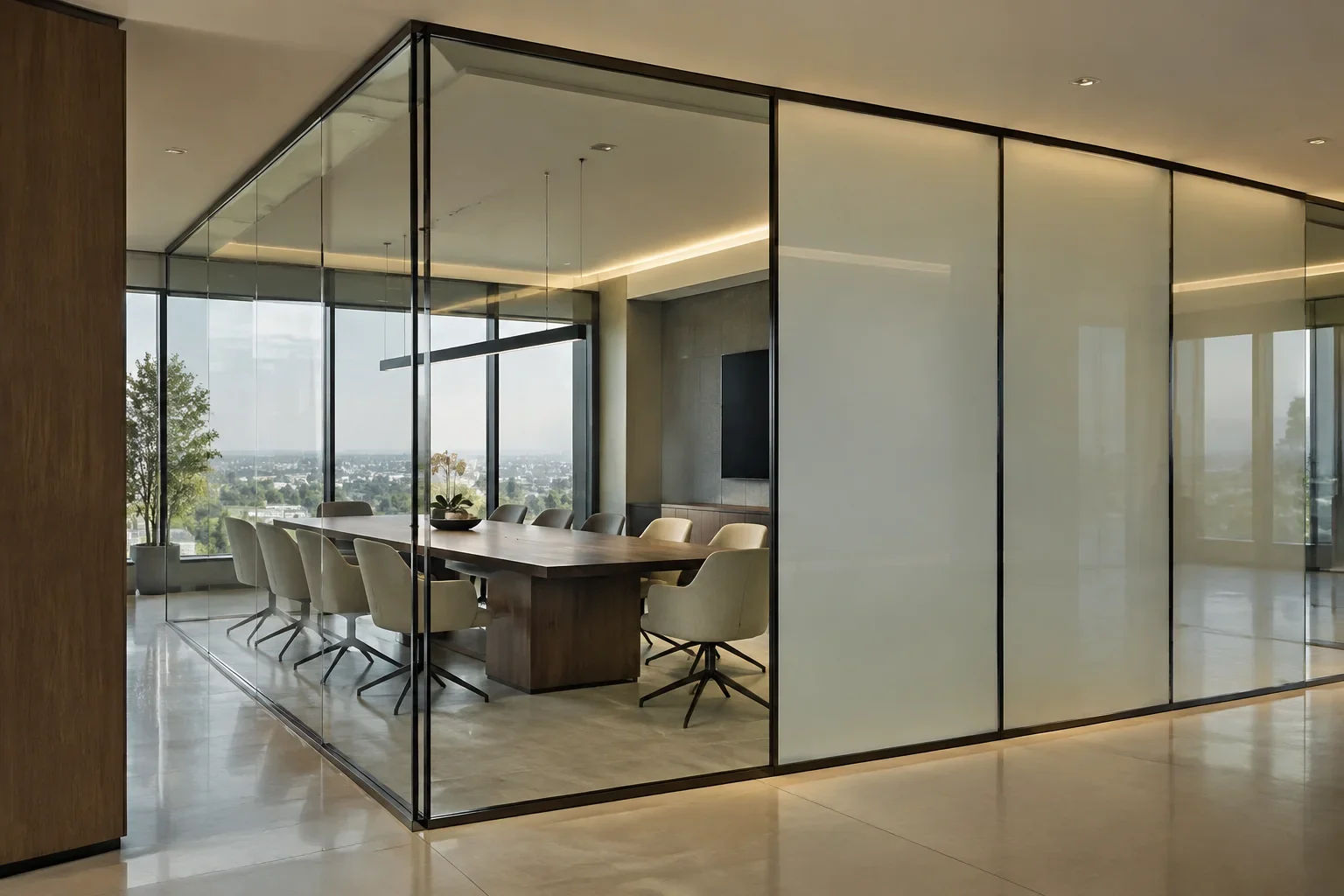
Glass offices bring daylight and visual connection into the workplace, but they also expose meetings, screens, and everyday activity. Switchable privacy glazing helps designers preserve an open architectural language while giving occupants control over visibility. The key decision is whether to apply smart film to existing glass or specify a new smart glass assembly.
For most office projects, the smart film vs smart glass comparison starts with the existing conditions: can the current glazing stay, or does the design already call for replacement? From there, appearance, door hardware, wiring routes, and construction sequencing determine the better fit. Both options deserve to be evaluated as complete installed systems—not simply as materials priced by area.
How PDLC Office Privacy Works
PDLC stands for polymer-dispersed liquid crystal. In standard PDLC products, applying power changes the orientation of liquid crystals so the glazing appears clear. Without power, it takes on a frosted appearance that obscures views while still admitting diffuse light.
That distinction matters: frosted does not mean blackout. PDLC is primarily a visual privacy technology, not a substitute for room-darkening treatments. Perceived privacy can also depend on lighting, viewing angle, and how close people or objects are to the surface. Review samples under conditions that resemble the intended office.
Smart Glass Technologies offers both approaches under the PriWatt™ brand. PriWatt Smart Film is self-adhesive PDLC applied to suitable existing glazing. PriWatt Smart Glass incorporates PDLC into a laminated glass assembly and is available in an insulated glass unit configuration. Explore the underlying technology in our guide to how smart glass works.
Smart Film vs Smart Glass at a Glance
| Decision factor | PriWatt Smart Film | PriWatt Smart Glass |
|---|---|---|
| Primary application | Retrofit of suitable existing office glass | New glazing or planned glass replacement |
| Construction approach | Self-adhesive PDLC film applied to the glass surface | PDLC incorporated into laminated glass or an IGU configuration |
| Existing partitions | May retain glazing and framing after assessment | Requires coordination of the new glass with framing and supports |
| Finish considerations | Film edges, surface care, and wiring details need attention | Glass edges, frame interfaces, and electrical connections need coordination |
| Standard unpowered state | Frosted | Frosted |
| Product price | $70/sq ft | $145/sq ft |
| Installation price | $30/sq ft | $50–$100/sq ft |
| Product warranty | 2 years | 3 years |
| Installation warranty | 1 year | 1 year |
Use these prices to begin a budget discussion, then obtain a written project quote. The final scope should identify the glazing, installation, electrical coordination, control requirements, and any work needed at existing partitions. Written warranty terms accompany every quote.
When Smart Film Is the Better Office Choice
You want to retain existing glass
Smart film is a strong candidate for an occupied office with serviceable conference-room fronts, private-office partitions, or glass doors. Instead of replacing the glazing solely to add switchable privacy, the project can focus on preparing the existing surface, fitting the film, and integrating power and controls.
Suitability still needs an on-site assessment. Glass condition, existing coatings, surface access, frame geometry, and door operation can affect the installation. A retrofit should not be specified on the assumption that every glass surface is ready to receive film.
Your renovation scope is focused on privacy
If the layout, framing, and doors already work, replacing them may add unnecessary construction scope. Film allows the design team to focus the intervention on visual privacy while retaining much of the existing architecture. This can be particularly useful for tenant improvements where the goal is to upgrade meeting rooms without rebuilding the office frontage.
Retention does not eliminate construction coordination. Crews still need access for templating, surface preparation, installation, and wiring. Discuss occupied areas, furniture protection, and room availability with the general contractor before establishing the work sequence.
You can accommodate surface-applied detailing
Film sits on the glass surface, so its edges and cleaning requirements deserve explicit attention. The design review should address perimeter detailing, hardware clearances, and how electrical connections will be concealed. In a well-planned retrofit, these details belong in the scope from the outset rather than becoming field decisions near completion.
When Smart Glass Is the Better Office Choice
You are already installing new partitions
For a new office build-out or a substantial renovation, smart glass can be specified as part of the glazing package. The switchable layer is incorporated into the laminated assembly rather than applied as a retrofit surface treatment. This makes it a natural option when glass replacement is already included in the project.
Architects and contractors should coordinate the proposed assembly with the framing, door hardware, supports, and applicable project requirements. Smart glass is not a reason to bypass normal glazing review; it adds electrical and control interfaces to that review.
You want an integrated glazing solution
Executive suites, client-facing conference rooms, and premium workplace interiors often benefit from planning the privacy function alongside the surrounding architecture. Smart glass lets the team address glass composition, frame profiles, and connection locations together. The result depends on those details, not simply on choosing a laminated product.
The embedded switchable layer also changes the surface-care discussion compared with applied film. Even so, the installed glass, edge conditions, and adjacent finishes require appropriate maintenance. Include product-specific care instructions in the facilities handover.
Your project needs a broader glazing review
Some office applications involve exterior windows or an IGU rather than interior partitions. In those cases, evaluate the entire assembly for the project's thermal, structural, and other requirements. PDLC privacy performance alone does not establish energy performance, and the choice between film and glass should not replace an envelope consultant's assessment.
Compare Installed Scope, Not Just Material Cost
PriWatt Smart Film is priced at $70/sq ft plus $30/sq ft for installation. PriWatt Smart Glass is priced at $145/sq ft, with glass installation at $50–$100/sq ft. The difference is meaningful, but the right comparison is the scope each option solves.
Film can make sense when it preserves glazing that would otherwise remain in use. Smart glass may fit better when a new partition system is already funded and coordinated. Ask whether proposals address removal, framing adjustments, electrical interfaces, and controls, rather than assuming that similarly labeled line items include identical work.
Warranty terms also belong in the evaluation. PriWatt Film carries a 2-year product warranty, PriWatt Glass carries a 3-year product warranty, and installation carries a 1-year warranty. Review the written conditions and care requirements through our warranty information, and use the smart glass cost guide to prepare your budget questions.
Privacy, Acoustics, and Controls: Set the Right Expectations
Visual privacy is not acoustic privacy
A frosted meeting-room wall can obscure views, but it does not establish speech confidentiality. Acoustic performance depends on the complete partition system, including the glass assembly, frames, seals, doors, and surrounding construction. Adding smart film should not be treated as an acoustic upgrade. Evaluate any required sound isolation separately.
Review the clear and frosted appearance
Do not assume switchable glazing will look identical to ordinary glass in every condition. Review clarity, visible haze, reflected light, and the frosted effect using a representative sample or mockup. Include the actual viewing distances and lighting relationships where practical, especially near presentation screens or highly illuminated work areas.
Decide what happens when power is off
Standard PriWatt PDLC film and glass become frosted without power. That may support the desired privacy behavior, but the team should consider its effect on sightlines and room operations. If the brief requires a clear unpowered state, PriWatt Reverse products use PNLC technology and should be evaluated as a separate option.
Controls also need an intentional design. Decide whether occupants will use a local control or an integrated automation interface. Smart Glass Technologies supports integration with Lutron, Crestron, and Control4; the control intent and required interfaces should be confirmed during project planning.
Why Turnkey Installation Is the Deciding Advantage
The most important choice is often not film versus glass, but who will take responsibility for turning the specification into a finished installation. Poorly coordinated dimensions, exposed connections, or unresolved wiring routes can compromise an otherwise thoughtful design.
Smart Glass Technologies provides full turnkey installation, not a DIY kit. The service includes laser templating, custom fabrication in Miami, certified installation crews, low-voltage wiring, busbar concealment, and automation integration. That coordinated scope helps architects, contractors, and owners address the interfaces between glazing, electrical work, and finished interiors.
Founded in 2018, Smart Glass Technologies is headquartered and manufactures in Miami, Florida, with Made in the USA products. The company has installed 200,000+ sq ft and has local installers across 26+ US metros. UL and SGCC certifications support the product conversation; request documentation applicable to the proposed assembly during submittal review.
For project planning, check your service area and review available formats, including office partitions, doors, and room dividers. Early coordination gives the team an opportunity to resolve concealment and access before finishes are complete.
Practical Buyer Checklist
- Document existing conditions: identify glazing to remain, glass condition, frame details, and door hardware.
- Define the privacy objective: distinguish visual screening from blackout, screen concealment, and acoustic confidentiality.
- Review a representative sample: evaluate powered and unpowered appearance under relevant lighting.
- Confirm the construction approach: choose retrofit film or a new glass assembly based on the overall renovation scope.
- Coordinate electrical details: establish wiring routes, connection concealment, service access, and responsibilities.
- Specify control behavior: document occupant operation, automation interfaces, and the intended power-off state.
- Compare complete proposals: review product, installation, related work, warranty terms, and maintenance instructions.
- Plan the handover: provide facilities staff with operating guidance and product-specific cleaning requirements.
Choose the Solution That Fits Your Office
Choose smart film when suitable existing glass should remain and the project is primarily a privacy retrofit. Choose smart glass when new glazing is already part of the design and an integrated assembly suits the construction plan. In either case, turnkey execution is what brings the material, wiring, controls, and architectural details together.
Request project pricing from Smart Glass Technologies to compare the right installed solution for your office.
Frequently Asked Questions
Is smart film or smart glass better for an existing office?
Smart film is often the better starting point when existing glazing and framing are suitable to remain. Smart glass is worth evaluating when the renovation already includes glass replacement or new partitions. An assessment should confirm surface condition, hardware clearances, and wiring routes.
How much do PDLC smart film and smart glass cost?
PriWatt Smart Film costs $70/sq ft plus $30/sq ft for installation. PriWatt Smart Glass costs $145/sq ft, with glass installation at $50–$100/sq ft. Request a written quote to confirm the complete project scope.
Does PDLC glazing provide soundproofing for conference rooms?
PDLC provides visual privacy, not a standalone soundproofing solution. Speech privacy depends on the complete partition assembly, including glass, framing, seals, doors, and adjacent construction. Assess acoustic requirements separately.
What happens to PDLC smart film and glass during a power outage?
Standard PriWatt PDLC smart film and smart glass become frosted without power. If your office requires a clear unpowered state, evaluate PriWatt Reverse products, which use PNLC technology.
Does Smart Glass Technologies handle installation and controls?
Yes. Smart Glass Technologies provides turnkey service including laser templating, custom fabrication in Miami, certified installation crews, low-voltage wiring, busbar concealment, and automation integration with Lutron, Crestron, and Control4. The company is not a DIY kit seller.