
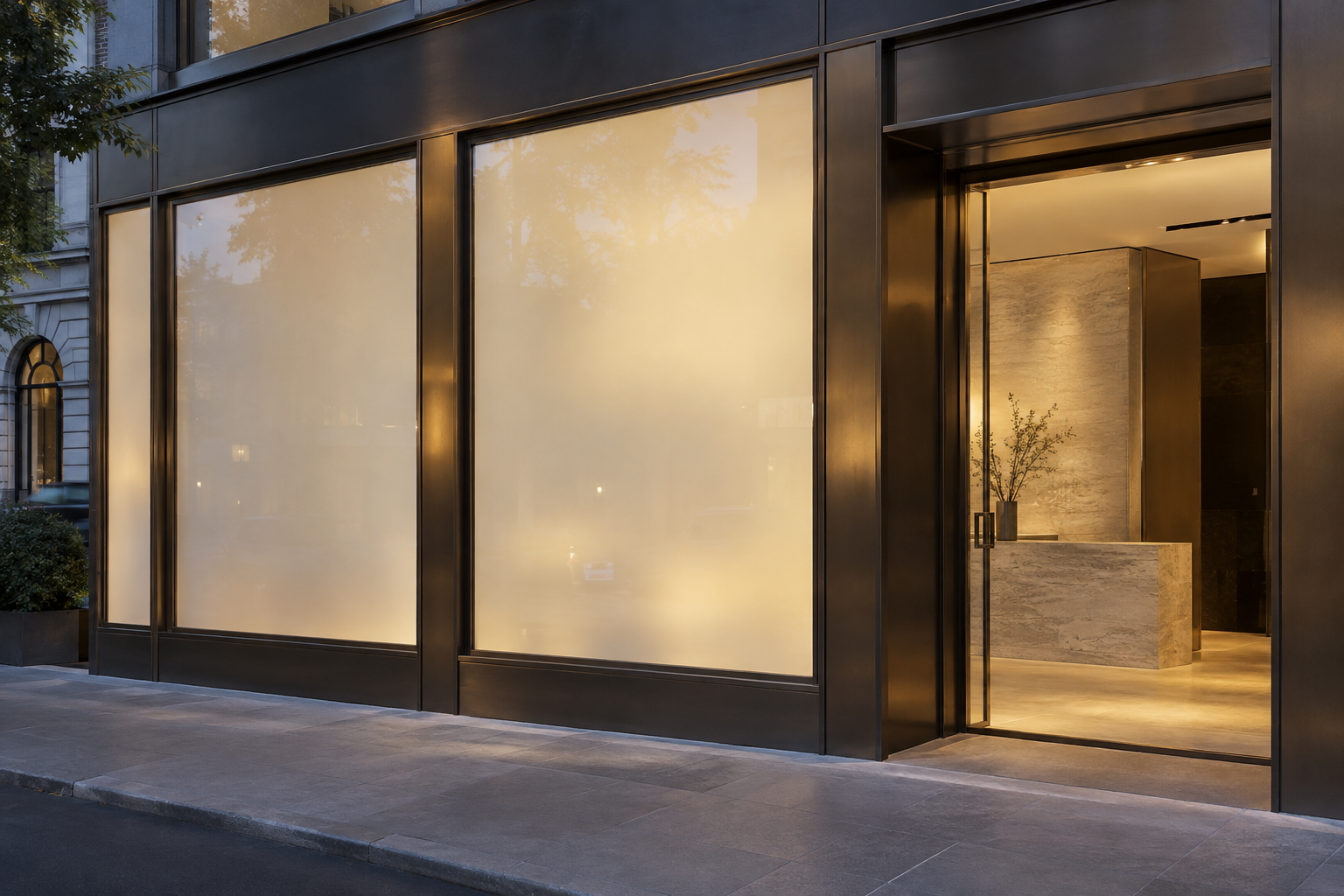
A glass storefront puts merchandise, interiors, and brand experience on display. After closing, however, that same transparency can expose restocking, cleaning, private appointments, or an unfinished merchandising reset. A smart film storefront can change from clear to frosted without adding curtains or permanently covering the glazing.
The best result depends on more than selecting switchable film. Existing glass conditions, door movement, wiring routes, and the desired behavior when power is off all affect the design. Smart Glass Technologies (Smart Glass Tech US) provides a full turnkey installation service, combining laser templating, custom fabrication in Miami, certified installation crews, low-voltage wiring, concealed busbars, and automation integration. For storefront projects, that coordinated scope is the main reason to choose a specialist rather than a DIY kit.
How Smart Film Creates After-Hours Privacy
PriWatt™ Smart Film is a self-adhesive retrofit product that uses polymer-dispersed liquid crystal technology, or PDLC. Applied to suitable existing glass, it appears frosted when off and becomes clear when powered. During business hours, the storefront can remain transparent. At closing, switching the film off obscures direct views through the treated glass.
The frosted state scatters light rather than making the storefront black or completely lightproof. Interior lighting may remain visible, and nearby objects or people can produce silhouettes depending on their position and the lighting conditions. Treat it as a visual privacy layer, not a blackout shade.
This distinction matters for luxury retail, appointment-only showrooms, and street-facing studios. If the goal is to hide routine closing activities, the frosted state may suit the brief. If sensitive merchandise must never be discernible, evaluate a representative sample under actual nighttime lighting and consider additional screening where necessary. Our guide to how smart glass works explains the switching principle.
Choose the Right Power-Off Behavior
After-hours privacy usually favors a product that is frosted without power. Standard PriWatt Smart Film supports that operating pattern: powered clear while open, then off and frosted after closing. It also defaults to frosted during a power interruption, provided the film is functioning as intended.
PriWatt Reverse Smart Film uses polymer-network liquid crystal technology, or PNLC, and is clear when off. That reversed behavior can suit a storefront where maintaining an unpowered transparent view is the priority. It is generally a different operational choice from a storefront whose primary objective is privacy when closed.
| Option | Power-off state | Storefront consideration | Published product price |
|---|---|---|---|
| PriWatt Smart Film | Frosted | Retrofit privacy for suitable existing storefront glazing | $70/sq ft plus $30/sq ft installation |
| PriWatt Reverse Smart Film | Clear | For projects prioritizing transparency when power is off | $120/sq ft; confirm installation scope in the quote |
| PriWatt Smart Glass | Frosted | PDLC laminated glass or IGU for replacement or new glazing | $145/sq ft plus $50–$100/sq ft glass installation |
| PriWatt Reverse Smart Glass | Clear | PNLC glass where an unpowered clear state suits the brief | $185/sq ft plus $50–$100/sq ft glass installation |
When existing glass is suitable and remaining in place, retrofit film is the relevant starting point. When a project already involves replacing glazing, integrated smart glass deserves consideration. Review the broader smart glass cost guide alongside a project-specific assessment rather than comparing product prices alone.
Design Around the Storefront Experience
Decide What Should Remain Visible
Privacy does not have to mean treating every pane identically. A retailer may want to screen a consultation area while keeping a display visible. A design showroom may prefer a fully frosted frontage during resets, then restore transparency for evening events. Define these operating scenarios before fabrication so the team can plan suitable film coverage and control zones.
Coordinate the privacy layout with merchandising, signs, and the customer entrance. A frosted frontage changes how a business presents itself from the sidewalk. Review whether customers can still recognize the entry and understand when the business is open, especially if appointments continue after normal trading hours.
Review Daytime Clarity and Nighttime Privacy
A sample review should include both states. Assess the clear appearance against merchandise, finishes, and exterior reflections. Do not assume switchable film will look identical to untreated glass from every angle or under every lighting condition.
For the frosted state, inspect the storefront from outside with interior lighting set as it will be after closing. Move representative displays and objects near the glass to understand silhouette visibility. This practical review gives owners and designers a shared expectation before the final installation.
Confirm the Existing Glass Is a Suitable Retrofit Surface
Storefront glass can include coatings, existing applied films, signs, sealants, and varying surface conditions. The installation team should assess compatibility and determine what preparation or removal is needed. Do not assume a film can simply be layered over another treatment.
Edges also deserve attention. Exposure to moisture, cleaning methods, and adjacent framing can affect the installation approach. Confirm the intended application surface and detailing with the project team rather than assuming the product is suitable for an exposed exterior face.
Smart film does not change the underlying storefront into security glazing or establish compliance with safety-glazing requirements. The architect and glazing contractor should retain responsibility for the required glass assembly, applicable codes, and any separate security provisions. If existing glazing needs replacement for other reasons, address that before committing to a retrofit.
Why Turnkey Installation Matters for Storefronts
A storefront is viewed close up, in changing daylight, and from both sides. Visible cable runs, awkward edge details, and poorly coordinated controls can undermine an otherwise refined interior. Smart Glass Tech US manages the switchable-film scope as an installed system rather than shipping a film kit and leaving integration to the buyer.
Laser Templating and Custom Fabrication
Field measurements establish the actual glass geometry and help coordinate film boundaries with frames, hardware, and adjacent finishes. Custom fabrication in Miami follows the project layout. This is particularly valuable where existing storefront panes differ or doors require careful coordination around fittings.
Busbar Concealment and Low-Voltage Wiring
The film needs electrical connections, including busbars that distribute power across the material. Their placement should be coordinated with framing and trim so the finished storefront remains visually clean. Wiring paths, power-supply locations, and service access should be resolved before finishes are closed.
Operable doors need their own review. Cable routing must accommodate movement without creating an exposed snag or interfering with hardware. The general contractor should coordinate these details with the storefront, electrical, and finish trades rather than treating them as a last-minute accessory installation.
Certified Crews and Automation Integration
Certified installation crews handle film application and system integration within the agreed scope. Smart Glass Tech US also supports integration with Lutron, Crestron, and Control4. The project team can therefore plan privacy as part of the building's operating routine rather than relying solely on staff remembering a separate switch.
Headquartered and manufacturing in Miami, Florida, the company offers USA-made products and local installers across 26+ US metros. Check the service area early to coordinate local project coverage and scheduling.
Plan a Clear Opening and Closing Sequence
Write down what the storefront should do during opening, closing, cleaning, and private events. For standard PDLC film, the closing sequence can switch the film off to create the frosted state. The opening sequence can restore the clear state when the space is ready for public view.
Confirm which functions belong to the privacy system and which belong to lighting, access control, or other building systems. Include a suitable staff override and determine who may use it. During handover, test the agreed operating scenes and verify what happens after a power interruption and restoration.
Privacy film is not a replacement for locks, intrusion detection, shutters, or other security measures. It can obscure views, but it does not make the underlying glass resistant to forced entry. Likewise, do not assume that a visual privacy upgrade delivers a specified acoustic or energy benefit without separate supporting documentation.
Storefront Buyer Checklist
- Define the privacy objective: Identify whether you are screening cleaning, merchandise resets, consultations, or another activity.
- Choose the default state: Decide whether the storefront should be frosted or clear when power is off.
- Assess existing glazing: Review glass condition, coatings, applied graphics, framing, and suitability for retrofit film.
- Approve a lighting sample: Check clear-state appearance and frosted-state privacy from the sidewalk.
- Map coverage and zones: Identify display panes, entrances, and areas that need independent operation.
- Coordinate installation details: Resolve busbar concealment, door wiring, power-supply access, and trade responsibilities.
- Document controls: Specify opening and closing behavior, automation integration, and manual override.
- Review the written scope: Confirm preparation, installation, controls, maintenance instructions, and warranty terms.
Budget for the Installed System and Ongoing Care
For standard PriWatt Smart Film, published pricing is $70/sq ft for film plus $30/sq ft for installation. Use those figures as a starting point, then request a written scope covering the actual storefront conditions. Ask how preparation, electrical coordination, automation, and access requirements are addressed rather than assuming every project has identical requirements.
PriWatt Film carries a 2-year warranty, PriWatt Glass a 3-year warranty, and installation a 1-year warranty. Written terms accompany every quote; review the warranty information and applicable project terms. At handover, ensure the cleaning team receives approved care instructions, particularly for film surfaces, edges, and electrical connections.
Plan your storefront privacy with a turnkey installation team. Request pricing with your storefront photos, drawings, and desired after-hours operation.
Frequently Asked Questions
Does smart film make a storefront completely opaque after closing?
Standard PriWatt Smart Film becomes frosted when off and obscures direct views, but it is not a blackout treatment. Light and silhouettes may remain visible depending on interior lighting and how close objects are to the glass. Review a sample under your actual nighttime conditions.
Can smart film be installed on existing storefront glass?
PriWatt Smart Film is a self-adhesive retrofit product for suitable existing glass. An assessment should confirm surface condition, compatibility with coatings or existing treatments, edge details, and wiring routes before installation.
What happens to storefront smart film during a power outage?
Standard PDLC PriWatt Smart Film is frosted when off. PriWatt Reverse Smart Film uses PNLC technology and is clear when off. Select the product according to the default state your storefront needs.
How much does storefront smart film cost?
PriWatt Smart Film is $70/sq ft plus $30/sq ft for installation. Request a written project quote to confirm preparation, controls, electrical coordination, and the complete installation scope.
Can storefront privacy be integrated with automation?
Yes. Smart Glass Tech US provides turnkey installation with automation integration for Lutron, Crestron, and Control4. Define the desired opening and closing sequence, staff override, and power-restoration behavior during planning.