
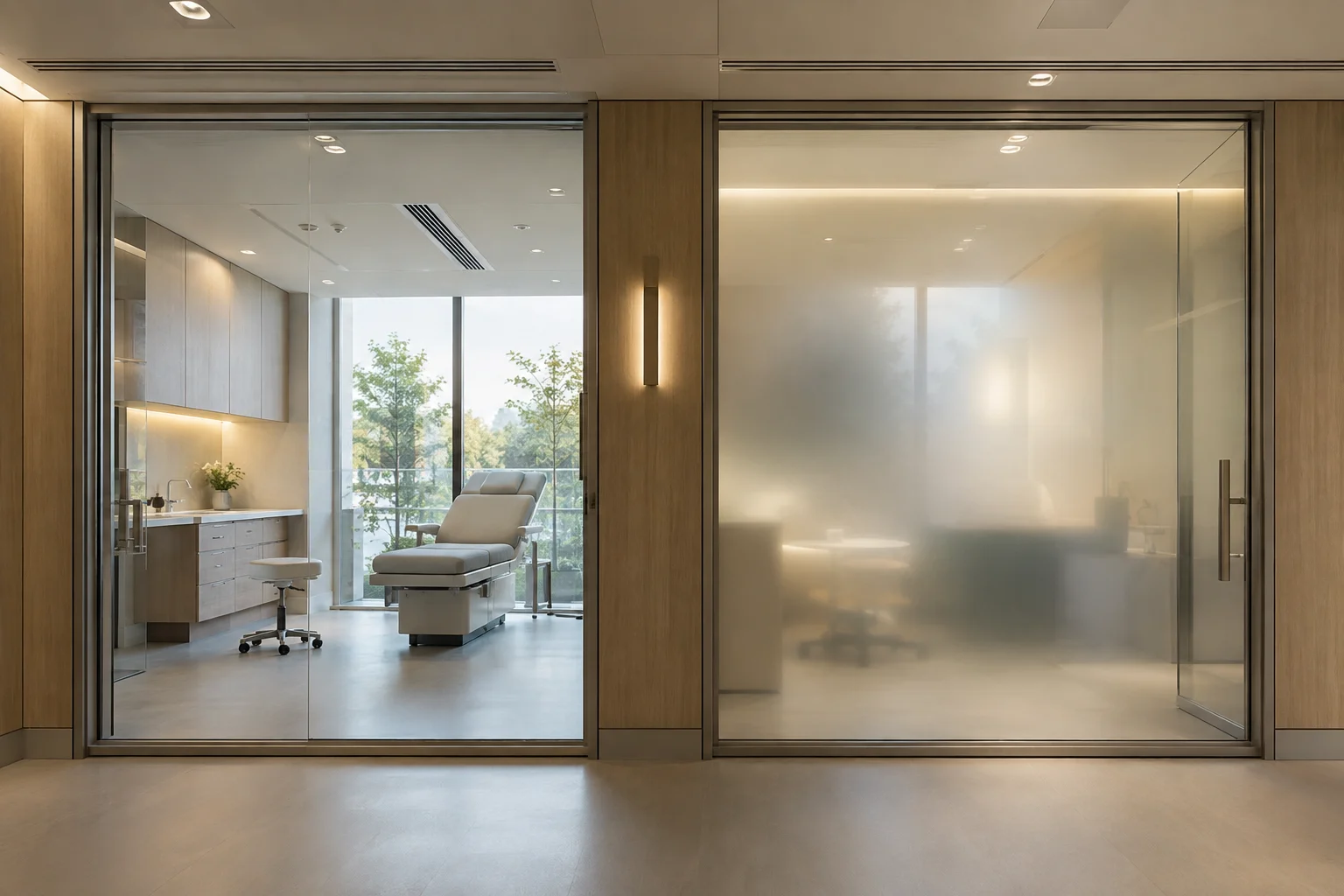
Healthcare interiors must support competing needs: patient dignity, staff visibility, daylight, and efficient movement. A glazed partition can make a treatment area feel open, yet the same transparency may be inappropriate during an examination or a sensitive conversation. Switchable privacy glass for hospitals allows designers to change visual conditions without adding a separate curtain or blind across every glazed opening.
The success of that system depends on more than the glass. Power routing, operating logic, framing, cleaning compatibility, and installation sequencing all affect the finished result. Smart Glass Technologies provides full turnkey service, from laser templating and custom fabrication in Miami to certified installation, low-voltage wiring, busbar concealment, and automation integration. For healthcare projects, that coordinated scope is a central reason to choose an installation partner rather than a standalone product supplier.
How Switchable Privacy Glass Works in Healthcare
PriWatt™ Smart Glass uses a laminated PDLC switchable layer to change between a frosted privacy state and a clear state. Standard PDLC is frosted when power is off. PriWatt Smart Film brings the same general switching principle to suitable existing glazing through a retrofit self-adhesive film. Learn more about the operating principles in our guide to how smart glass works.
The frosted state scatters light to obscure views while allowing light through. It should not be specified as blackout glazing or assumed to conceal every silhouette under every lighting condition. Patient proximity, viewing angle, and illumination on either side influence perceived privacy. A representative mockup is valuable when visual screening is central to the room's function.
PriWatt Reverse Smart Film and PriWatt Reverse Smart Glass use PNLC technology and are clear when power is off. That difference matters in healthcare: the desired unpowered state should come from a room-by-room clinical and safety review, not simply an aesthetic preference.
Where Privacy Glass for Hospitals Can Be Useful
Examination and consultation rooms
Glazed examination rooms can share light with adjoining spaces while switching to a frosted state for patient care. Consultation rooms may also benefit from a more private visual setting during sensitive discussions. However, visual screening does not provide speech privacy. Door seals, wall construction, glazing assemblies, and mechanical pathways require separate acoustic consideration.
Patient-room observation panels
Switchable glazing can support a deliberate balance between observation and dignity at patient-room entrances or internal windows. The clinical team should define who controls the panel, when visibility is needed, and how staff regain the required view. Neither the default state nor a control override should be selected without reviewing the care workflow.
Treatment bays and shared care areas
In shared treatment environments, switchable partitions can create adaptable visual boundaries. Designers should assess the full sightline, including doors, joints, and uncovered areas, rather than treating the switchable panel as the entire privacy solution. Equipment placement and patient circulation also influence whether a proposed partition layout works in practice.
Specialty clinics and premium healthcare interiors
Outpatient centers, dental practices, and specialty clinics often seek a calm, residential-quality atmosphere without abandoning practical room planning. Switchable glass can provide a restrained alternative to visually busy screening systems. High-end appearance should still be paired with service access, durable detailing, and a cleaning approach approved for the selected assembly.
Choosing Between Retrofit Film and New Smart Glass
The first question is whether existing glazing can remain. Retrofit film may suit a renovation where the glass and framing are appropriate for reuse. New smart glass may be preferable when partitions are being rebuilt or the project requires a coordinated laminated-glass or insulated-glass assembly. Product suitability should be reviewed before procurement.
| Product | Typical project fit | Unpowered state | Listed product pricing |
|---|---|---|---|
| PriWatt Smart Film | Retrofit to suitable existing glazing | Frosted | $70/sq ft plus $30/sq ft installation |
| PriWatt Reverse Smart Film | Retrofit where a clear unpowered state is required | Clear | $120/sq ft; confirm installation scope in the quote |
| PriWatt Smart Glass | New laminated glazing or IGU applications | Frosted | $145/sq ft; glass installation is $50–$100/sq ft |
| PriWatt Reverse Smart Glass | New glazing where a clear unpowered state is required | Clear | $185/sq ft; glass installation is $50–$100/sq ft |
These prices are a starting point for product comparisons, not a complete hospital project estimate. The quote should identify the glazing configuration, wiring, controls, installation scope, and coordination responsibilities. Visit the smart glass cost guide for budgeting context and request a project-specific scope before finalizing allowances.
Electrochromic and SPD glazing serve different light-management objectives and should not automatically be treated as substitutes for frosted visual privacy. Compare the actual behavior of a proposed system against the clinical need. If the goal is to obscure views, confirm that function rather than relying on a general description such as “tintable glass.”
Healthcare Requirements to Resolve Before Specification
Privacy performance and room lighting
Review the glass from both sides under realistic daytime and nighttime conditions. Include the positions where patients may sit, stand, or receive care. A frosted appearance in a showroom is not a substitute for evaluating the intended room. Where complete visual concealment is required, the design team should assess whether supplemental screening is necessary.
Cleaning and infection-prevention review
Switchable glazing can replace some fabric screening in appropriate layouts, but it should not be presented as preventing infection or eliminating cleaning. Healthcare teams should review cleaning-product compatibility, exposed film surfaces, edge protection, joints, and access for maintenance. Obtain approved care instructions and align them with environmental-services procedures before specifying the system.
Safety, acoustics, and regulatory coordination
Smart Glass Technologies is UL and SGCC certified. The design team should still request the documentation relevant to the specified product and assembly. Switchability alone does not establish a fire rating, an acoustic rating, or suitability for every clinical environment. Safety glazing, impact exposure, accessibility, and applicable project requirements need independent review.
Similarly, privacy glass is one component of a broader patient-privacy strategy, not a standalone guarantee of regulatory compliance. Acoustic separation, access policies, room planning, and staff practices remain essential. For exterior windows, evaluate thermal and solar performance as part of the full glazing assembly rather than assuming privacy switching delivers a particular energy benefit.
Plan Controls Around Clinical Workflow
Control placement should make the system understandable to staff without creating uncertainty about room status. Decide whether patients should have local control, whether staff require an override, and whether individual panels or entire rooms should switch together. Document normal operation and expected behavior during a power interruption.
Smart Glass Technologies supports automation integration with Lutron, Crestron, and Control4. Integration can bring privacy switching into a coordinated room-control strategy, but the operating sequence should be defined and reviewed with the project team. Hospital-specific systems or unusual control requirements should be discussed during design rather than assumed compatible.
Why Turnkey Installation Matters in Hospitals
A healthcare partition can look simple on an elevation while concealing several coordination challenges. The glass must fit accurately, electrical connections must remain discreet, and components must be accessible for service. Smart Glass Technologies is not a DIY kit seller: its full turnkey installation service addresses the relationship between product, wiring, controls, and architectural finish.
The process includes laser templating, custom fabrication in Miami, certified install crews, low-voltage wiring, busbar concealment, and automation integration. Busbars—the conductive connection areas that power the switchable layer—require deliberate detailing so they do not undermine the finished appearance. Early coordination also helps establish cable routes before surrounding finishes close them off.
For an occupied hospital, the general contractor and facility team should agree on work-area access, installation sequencing, and applicable site procedures. Include functional checks, staff handover, and maintenance documentation in the planned closeout scope. These conversations make the difference between purchasing switchable material and delivering a usable privacy system.
Headquartered and manufacturing in Miami, Florida, Smart Glass Technologies offers products made in the USA. Founded in 2018, the company has installed 200,000+ sq ft and works with local installers across 26+ US metros. Check service availability early to coordinate support for your location.
A Practical Buyer Checklist
- Define the clinical objective: Identify where visual privacy, observation, or shared daylight takes priority.
- Review existing conditions: Determine whether glazing is suitable for retrofit film or should be replaced.
- Select the unpowered state: Review frosted-off PDLC and clear-off PNLC with clinical stakeholders.
- Validate sightlines: Evaluate a representative sample or mockup under realistic lighting.
- Coordinate the assembly: Confirm framing, door operation, wiring paths, busbar concealment, and service access.
- Approve cleaning procedures: Check proposed cleaning products and methods against written care guidance.
- Document controls: Establish switching zones, user permissions, override needs, and power-interruption behavior.
- Confirm scope and support: Review installation responsibilities, handover requirements, and written warranty terms.
Plan for Long-Term Ownership
Warranty coverage should be clear before purchase. PriWatt Glass carries a 3-year warranty, PriWatt Film carries a 2-year warranty, and installation carries a 1-year warranty. Written terms accompany every quote; review those terms alongside the proposed application and maintenance plan. The warranty page provides a useful starting point.
For related applications, explore available smart glass formats and the knowledge center. A successful hospital installation begins with the room's needs and ends with coordinated delivery—not simply a panel that changes appearance.
Planning privacy glass for a hospital or healthcare renovation? Request project pricing from Smart Glass Technologies for a tailored product recommendation and turnkey installation scope.
Frequently Asked Questions
Can privacy glass be added to existing hospital windows?
PriWatt Smart Film is a retrofit self-adhesive option for suitable existing glazing. The glass, framing, surface condition, electrical routing, and cleaning requirements should be reviewed before confirming suitability.
What happens to hospital privacy glass when the power goes off?
Standard PriWatt PDLC Smart Film and Smart Glass are frosted when off. PriWatt Reverse PNLC products are clear when off. The appropriate unpowered state should be selected with the clinical and facility teams.
Does switchable glass provide sound privacy or guarantee patient-privacy compliance?
No. Visual screening does not establish acoustic privacy or guarantee regulatory compliance. Speech privacy depends on the complete room assembly, while patient privacy also requires appropriate layouts, access policies, and staff practices.
How much does privacy glass for hospitals cost?
PriWatt Smart Film is $70/sq ft plus $30/sq ft installation. PriWatt Smart Glass is $145/sq ft, with glass installation at $50–$100/sq ft. Reverse Smart Film is $120/sq ft, and Reverse Smart Glass is $185/sq ft. Request a project-specific quote to confirm controls, wiring, installation, and other scope requirements.
What does Smart Glass Technologies' turnkey service include?
Turnkey service includes laser templating, custom fabrication in Miami, certified installation crews, low-voltage wiring, busbar concealment, and automation integration with Lutron, Crestron, or Control4. Project-specific responsibilities and operating requirements should be confirmed in the quoted scope.