
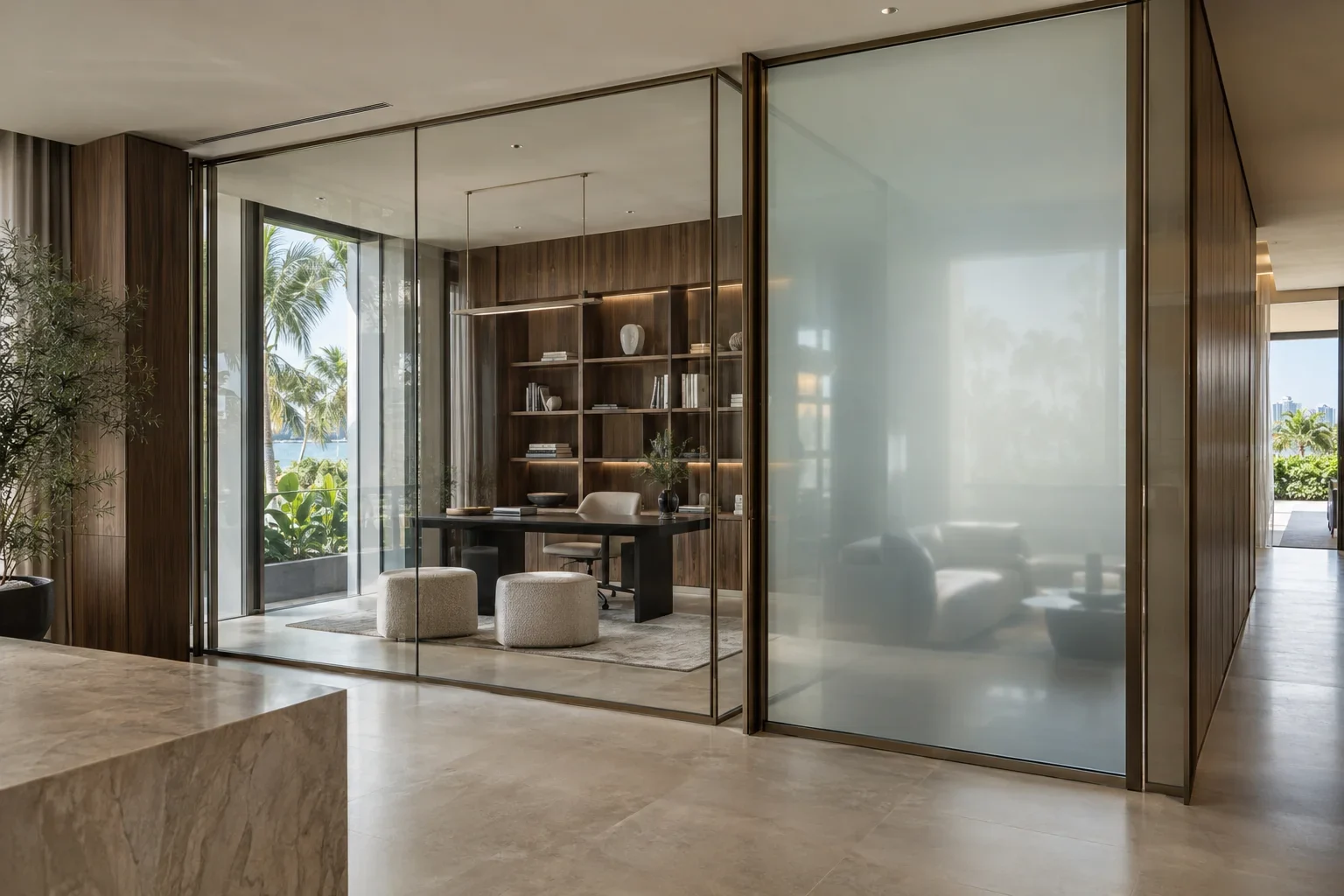
The central difference in PDLC vs PNLC smart glass is simple: conventional PDLC is frosted when power is off, while PNLC reverse smart glass is clear when power is off. Apply power, and each changes to its opposite visual state.
That distinction affects more than the wall switch. It shapes privacy during a power interruption, the way a room looks when systems are shut down, and which operating state requires power. For architects, contractors, designers, and homeowners, the right choice starts with how the space should function—not simply which technology sounds newer.
Smart Glass Technologies supplies both technologies through its PriWatt™ product range. More importantly, we deliver a complete turnkey installation, coordinating laser templating, custom fabrication in Miami, certified installation crews, low-voltage wiring, busbar concealment, and automation integration.
PDLC vs PNLC at a Glance
| Consideration | PDLC smart glass or film | PNLC reverse smart glass or film |
|---|---|---|
| Technology name | Polymer-dispersed liquid crystal | Polymer-network liquid crystal |
| Power-off appearance | Frosted | Clear |
| Powered appearance | Clear | Frosted |
| Default design priority | Privacy when unpowered | Visual openness when unpowered |
| Retrofit option | PriWatt Smart Film | PriWatt Reverse Smart Film |
| New glazing option | PriWatt Smart Glass | PriWatt Reverse Smart Glass |
| Typical selection question | Should this space become private when power is off? | Should this space remain visually open when power is off? |
Neither technology is universally better. A private consultation room and a view-oriented residential partition can have opposite requirements, even if their glass dimensions and architectural detailing are similar.
How PDLC Smart Glass Works
PDLC stands for polymer-dispersed liquid crystal. In its unpowered state, the liquid crystal arrangement scatters light, giving the glazing a frosted appearance. When an electrical field is applied, the liquid crystals align so that more light passes through without scattering, making the glass appear clear.
In practical terms, standard PDLC follows a familiar privacy-first sequence: power off means frosted; power on means clear. It can suit spaces where an unpowered partition should obscure the view, such as a bathroom enclosure, private office, or meeting room.
Frosted does not mean blackout. The glazing can continue to transmit light while obscuring direct views. Lighting, viewing distance, and proximity to the glass can affect the visibility of silhouettes, so privacy expectations should be checked against samples and the intended room layout. Our guide to how smart glass works explains the underlying concept.
How PNLC Reverse Smart Glass Works
PNLC stands for polymer-network liquid crystal. In the reverse-mode products discussed here, the liquid crystal structure is configured to provide a clear state without applied power. Applying power produces the light-scattering, frosted state.
The operating sequence is therefore reversed: power off means clear; power on means frosted. The word “reverse” describes this electrical behavior, not a different installation orientation or a reflective glass effect.
PNLC is worth considering when visual openness is the preferred resting state. A luxury home's interior partition might remain clear most of the time but become frosted for occasional privacy. An office layout might similarly prioritize open sightlines unless a meeting requires separation. The important trade-off is that privacy depends on power being available.
Choose the Power-Off State Before the Product
When privacy should be the default
If a room should be visually screened whenever its smart glazing is unpowered, PDLC is the more natural starting point. During a power interruption, the glazing returns to its frosted state. That behavior may align with the design intent for private rooms, but it should not replace a project-specific assessment of visual privacy.
Consider how close occupants will stand to the glass and whether strong lighting behind them could reveal silhouettes. Where sensitive privacy is essential, assess the full room arrangement rather than relying on the word “frosted” alone.
When openness should be the default
If uninterrupted sightlines are the preferred unpowered condition, PNLC reverse technology deserves consideration. It returns to clear when power is removed, supporting an open appearance when privacy mode is not needed.
That same behavior must be acceptable during an outage. A bathroom partition that unexpectedly becomes clear presents a different design concern from a living-room divider. Document the required power-off state in the specification so the owner, designer, electrical contractor, and glazing team are working toward the same result.
Smart Film vs Smart Glass: A Separate Decision
PDLC versus PNLC determines switching behavior. Film versus glass determines how the technology is incorporated into the project. These decisions are related, but they should not be treated as interchangeable.
Retrofit film for suitable existing glazing
PriWatt Smart Film is a self-adhesive PDLC retrofit product for suitable existing glass. PriWatt Reverse Smart Film provides the reverse operating behavior. A retrofit approach may preserve an existing partition or window assembly, subject to an assessment of the glazing, surface condition, edge details, and electrical access.
Existing glass should not automatically be assumed suitable. Frames, hardware, exposed edges, cleaning requirements, and environmental conditions all influence the recommended installation approach.
Smart glass for new or replacement assemblies
PriWatt Smart Glass is available as PDLC laminated glass or an insulated glass unit, while PriWatt Reverse Smart Glass uses PNLC technology. New or replacement glazing allows the design team to coordinate the glass assembly, framing, and electrical provisions together.
Project formats can include doors, office partitions, room dividers, windows, skylights, curved glass, railings, shower doors, and rear projection applications. Technology suitability and detailing should be confirmed for the specific use. Explore our smart glass formats when developing the design.
PDLC vs PNLC Pricing
Reverse technology carries a higher listed product price in the PriWatt range. Keep product pricing separate from installation allowances when comparing options.
| Product | Technology | Product price | Installation pricing |
|---|---|---|---|
| PriWatt Smart Film | PDLC | $70/sq ft | $30/sq ft |
| PriWatt Reverse Smart Film | PNLC | $120/sq ft | Confirm in project quote |
| PriWatt Smart Glass | PDLC | $145/sq ft | $50–$100/sq ft |
| PriWatt Reverse Smart Glass | PNLC | $185/sq ft | $50–$100/sq ft |
The final scope should identify glazing preparation, electrical coordination, access, controls, and installation responsibilities. A product-only comparison does not capture the work required to deliver a finished architectural system. Visit our smart glass cost guide for budgeting context and request a written project quote.
What Switching Technology Does Not Tell You
Choosing PDLC or PNLC does not, by itself, establish acoustic performance, solar control, or the suitability of a complete glazing assembly. Sound isolation depends on the glass construction, framing, seals, and surrounding building elements. Energy-related performance likewise requires evaluation of the overall window or facade system.
Electrochromic and suspended particle device technologies address different light-management priorities and should not be treated as direct substitutes for liquid-crystal privacy glazing without reviewing the intended effect.
Also review clear-state appearance in realistic conditions. Viewing angle, illumination, and the surrounding finishes influence how smart glazing is perceived. A representative sample is more useful than assuming either technology will look identical to ordinary clear glass in every setting.
Why Turnkey Installation Matters
A successful installation needs more than the correct switching layer. Visible wiring, poorly coordinated electrical access, or unfinished edges can undermine an otherwise carefully designed interior. Smart Glass Technologies is not a DIY kit seller: our core service is delivering the complete installed system.
We begin with laser templating and custom fabrication in Miami, then coordinate certified installation crews, low-voltage wiring, and busbar concealment. The busbars provide electrical connections to the switchable layer, so their placement should be resolved alongside framing and finish details—not left as an afterthought.
Automation integration with Lutron, Crestron, or Control4 can connect privacy operation to the broader room controls. The control sequence should reflect the selected technology, since removing power produces opposite results for PDLC and PNLC.
Headquartered and manufacturing in Miami, Florida, Smart Glass Technologies offers Made in the USA products. Founded in 2018, we have installed 200,000+ sq ft and have local installers across 26+ US metros. We are UL and SGCC certified; project documentation should confirm the applicable product and assembly requirements. Check service availability early in planning.
A Practical Buyer Checklist
- Define the default state: Decide whether the glass should be clear or frosted without power.
- Review outage behavior: Confirm that occupants understand what happens when power is lost.
- Assess privacy: Review samples, lighting, silhouettes, and viewing distances.
- Select the construction: Compare suitable retrofit film with new or replacement smart glass.
- Coordinate details: Resolve wiring paths, busbar concealment, framing, hardware, and electrical access.
- Document controls: Specify manual operation and any automation integration.
- Compare complete scopes: Check product, installation, electrical, and finish responsibilities.
- Review written warranties: PriWatt Glass carries 3 years, PriWatt Film 2 years, and installation 1 year. Written terms accompany every quote; see our warranty information.
Specify the Right Default—and the Complete Installation
The PDLC vs PNLC decision begins with one question: should your glazing be frosted or clear when power is off? From there, the best result comes from coordinating the product, electrical design, architectural details, and installation as a complete system.
Request pricing from Smart Glass Technologies to compare PriWatt options and plan your turnkey installation.
Frequently Asked Questions
What is the main difference between PDLC and PNLC reverse smart glass?
PDLC smart glass is frosted without power and clear when powered. PNLC reverse smart glass is clear without power and frosted when powered. The choice depends largely on which appearance you want as the default unpowered state.
What happens to smart glass during a power outage?
PDLC returns to its frosted state, while PNLC reverse smart glass returns to its clear state. This difference should be considered carefully for bathrooms, private offices, and other spaces where privacy during an outage matters.
Is PNLC reverse smart glass more expensive than PDLC?
In the PriWatt range, PDLC Smart Glass is $145/sq ft and PNLC Reverse Smart Glass is $185/sq ft. Glass installation is $50–$100/sq ft. PDLC Smart Film is $70/sq ft plus $30/sq ft installation; Reverse Smart Film is $120/sq ft, with installation confirmed in the project quote.
Does frosted smart glass completely block light and silhouettes?
No. Frosted smart glazing scatters light rather than creating a blackout barrier. Silhouette visibility depends on lighting, viewing distance, and how close a person or object is to the glass. Review representative samples for privacy-sensitive applications.
Does Smart Glass Technologies provide installation and automation integration?
Yes. Smart Glass Technologies provides turnkey service including laser templating, custom fabrication in Miami, certified installation crews, low-voltage wiring, busbar concealment, and integration with Lutron, Crestron, or Control4. We are not a DIY kit seller.