
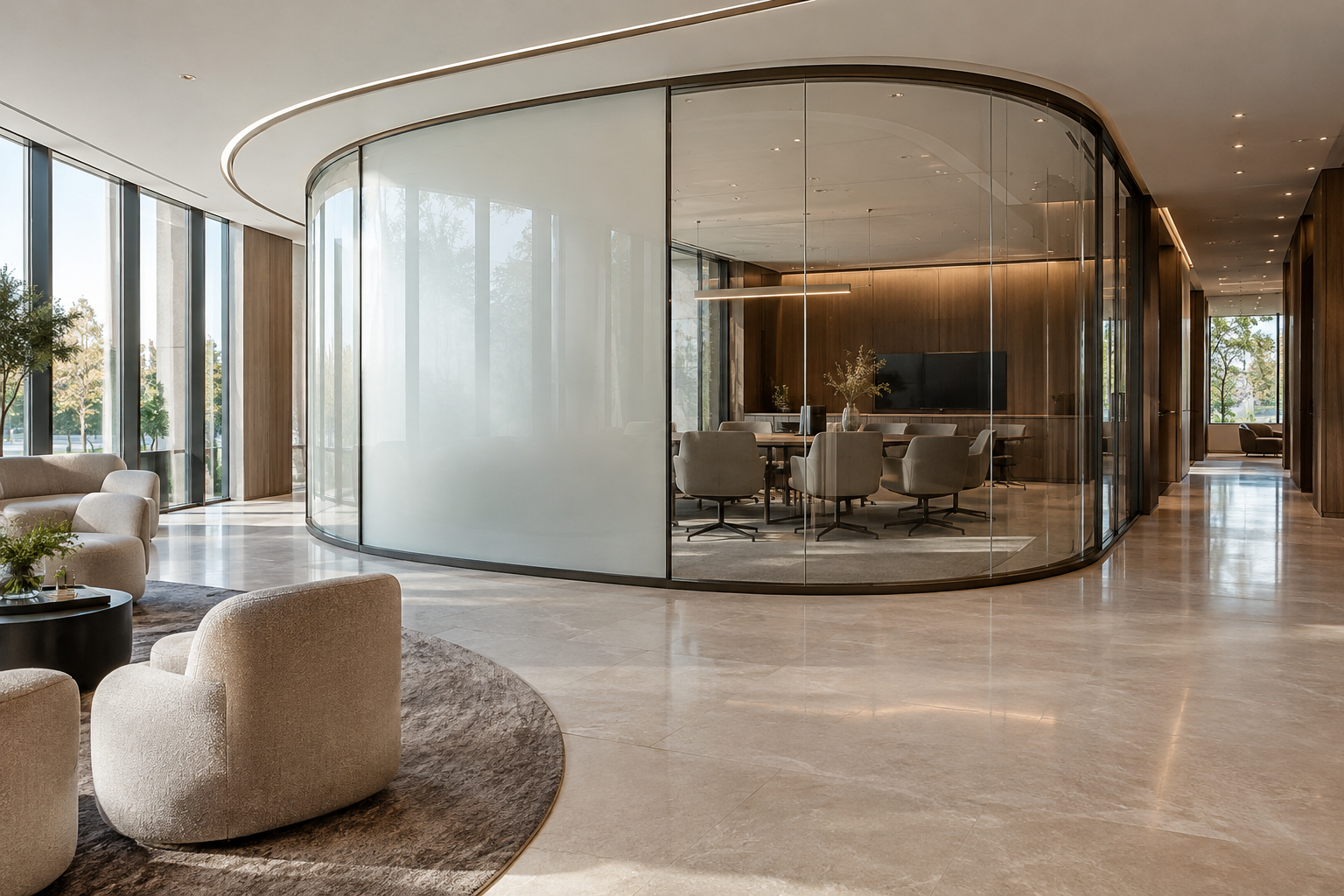
Curved smart glass can make a privacy partition feel like part of the architecture rather than an interruption to it. In a reception suite, private office, or luxury residence, a sweeping glazed enclosure can preserve visual continuity when transparent and create separation when switched to its privacy state.
For architects, the challenge is not simply choosing glass that changes appearance. Curvature affects fabrication, supporting details, electrical routing, installation access, and replacement planning. Those decisions need to work together before the glazing package reaches the field.
Smart Glass Technologies (Smart Glass Tech US) approaches these projects through full turnkey installation: laser templating, custom fabrication in Miami, certified installation crews, low-voltage wiring, busbar concealment, and automation integration. This coordinated service—not a DIY kit—is the central advantage for teams specifying complex architectural glazing.
What Is Curved Smart Glass?
Curved smart glass combines a curved glazing form with a switchable layer that changes its visual state when electrically controlled. The architectural intent might be an enclosed meeting room, a rounded room divider, or a curved window assembly. Each application requires review of the complete system, not just the switchable material.
The phrase can also describe different construction approaches. A project may use purpose-fabricated switchable laminated glass or evaluate retrofit smart film for an existing curved glass surface. These are not interchangeable specifications, and a film suitable for one geometry should not be assumed suitable for another.
Standard and reverse privacy behavior
PriWatt™ Smart Glass uses PDLC technology in laminated glass or an insulating glass unit configuration. PriWatt Smart Film is a self-adhesive PDLC retrofit product that is frosted when off and becomes transparent when energized. Standard PDLC privacy systems are useful where the preferred unpowered condition is visual screening.
PriWatt Reverse Smart Glass and PriWatt Reverse Smart Film use PNLC technology, with a clear off state. This distinction matters for operating schedules, control logic, and expectations during a power interruption. Curved project suitability and the proposed assembly must be confirmed before either technology is specified.
For a broader explanation of switching behavior, visit how smart glass works. Electrochromic and SPD technologies address variable tint and solar-control objectives differently; do not treat those categories as direct substitutes for a switchable privacy specification.
Start With Geometry, Not Just a Rendering
A convincing rendering does not establish whether a curved glazing assembly can be fabricated, transported, and installed as drawn. Early design review should identify the intended curve, panel boundaries, support conditions, and relationship to adjacent finishes.
Define the actual curved surface
Distinguish a continuous curved panel from a faceted arrangement of flat panels. Both can suggest a sweeping enclosure, but they produce different reflections, joints, and sightlines. Also distinguish a simple curve from a surface that curves in multiple directions. Do not assume the same product or fabrication approach can serve both.
Provide plans, sections, elevations, and the proposed glass build-up for review. Identify whether the design intent prioritizes uninterrupted curvature, minimal framing, privacy continuity, or alignment with surrounding millwork. Clear priorities help the fabrication and installation teams evaluate alternatives without losing the architectural concept.
Coordinate site measurement with finish readiness
Laser templating connects the design geometry to actual site conditions. Establish when floors, ceilings, structural supports, and adjacent wall finishes will be sufficiently resolved for measurement. Changes after templating can affect fit, joint consistency, and electrical access.
For commercial general contractors, this is a sequencing issue as much as a glazing issue. Assign responsibility for substrate readiness and dimensional approval before releasing custom fabrication.
Compare Glass and Retrofit Film Approaches
The choice between new smart glass and retrofit film begins with the existing conditions and performance brief. The following comparison is a planning guide, not confirmation that every product can accommodate every curve.
| Approach | Typical design context | Key coordination issue | Curved-project review |
|---|---|---|---|
| PriWatt Smart Film | Retaining suitable existing glazing with frosted-off privacy | Surface condition, exposed edges, wiring, and finish quality | Confirm compatibility with the actual curvature and glass surface |
| PriWatt Reverse Smart Film | Retaining suitable glazing where clear-off behavior is preferred | Control intent and retrofit detailing | Confirm film suitability and installation feasibility |
| PriWatt Smart Glass | New glazing or replacement assemblies using PDLC | Glass build-up, framing, fabrication, and electrical interfaces | Review the complete curved assembly before specification |
| PriWatt Reverse Smart Glass | New glazing where clear-off behavior is required | PNLC selection, support details, and control logic | Confirm geometry and fabrication feasibility for the proposed design |
Retrofit film does not correct damaged glass, unsuitable framing, or an inadequate underlying assembly. Conversely, replacing glazing solely to add switching functionality may be unnecessary where the existing surface is suitable. A coordinated feasibility review helps establish the appropriate path.
Detail the Electrical System as Part of the Architecture
Curved glazing often sits in highly visible locations, where a poorly placed cable or oversized cover can undermine the design. Electrical coordination should therefore begin alongside the frame and joint details—not after glass installation.
Plan busbar concealment and cable routes
Busbars distribute electrical power to the switchable layer. Their locations affect how edges, frames, and adjacent finishes are detailed. Establish the proposed connection edges and confirm how the installation team will conceal them while preserving necessary access.
Coordinate low-voltage wiring routes through approved framing or adjacent construction. Avoid details that depend on improvised field modifications. Door applications need additional review because moving leaves and hardware introduce different routing and maintenance requirements from fixed partitions.
Specify control behavior clearly
Describe how users should operate the glass and what state it should take when power is unavailable. For a meeting room, consider whether privacy controls should remain independent of lighting scenes. For a residence, consider how a local control should interact with broader automation.
Smart Glass Tech US provides integration with Lutron, Crestron, and Control4. Confirm the control interface, equipment locations, trade responsibilities, and commissioning sequence during design coordination. A named automation platform alone is not a complete controls specification.
Review Privacy, Appearance, and Application Requirements
Switchable privacy is a visual function, not a substitute for every other glazing requirement. A frosted state should not automatically be described as blackout. Lighting, viewing position, and proximity to the glass can influence perceived screening, so review representative samples under conditions relevant to the project.
Curvature also changes reflections and viewing angles across the surface. Evaluate the transparent and privacy states from circulation paths, seating positions, and adjacent rooms. Where appearance is particularly sensitive, discuss a representative mockup before approving the final assembly.
Acoustic separation depends on the complete enclosure, including glass construction, seals, doors, framing, and flanking paths. Likewise, solar control, UV performance, and energy behavior require review of the specified assembly rather than assumptions based on switchable operation.
For showers, railings, exterior windows, and other demanding applications, confirm safety, environmental exposure, edge protection, structural requirements, and applicable code obligations. Smart Glass Tech US is UL and SGCC certified; request documentation relevant to the proposed product and assembly rather than treating company credentials as approval of every custom detail. Explore available smart glass formats during concept development.
Budget for the Complete Installed Scope
Published product pricing provides a starting point, but it is not a curved-glass project quote. Geometry, assembly requirements, access, and installation coordination must be reviewed before establishing the project scope.
- PriWatt Smart Film: $70/sq ft plus $30/sq ft installation.
- PriWatt Reverse Smart Film: $120/sq ft; confirm installation scope in the quote.
- PriWatt Smart Glass: $145/sq ft.
- PriWatt Reverse Smart Glass: $185/sq ft.
- Glass installation: $50–$100/sq ft.
Ask for a written proposal identifying the selected product, fabrication scope, electrical work, controls integration, and installation responsibilities. Do not assume published pricing includes every project-specific curved detail. The smart glass cost guide can support initial planning.
A Practical Curved Smart Glass Buyer Checklist
- Document the geometry: provide drawings, panel divisions, support conditions, and the intended curved surface.
- Choose the off state: establish whether frosted-off or clear-off behavior best serves the space.
- Confirm product feasibility: obtain review of the proposed curvature, assembly, and application before final specification.
- Review visual expectations: assess samples and discuss a mockup where privacy or reflections are critical.
- Coordinate electrical details: identify connection edges, concealed cable routes, equipment access, and controls.
- Plan construction sequencing: align site readiness, laser templating, fabrication release, delivery access, and installation.
- Verify documentation: request relevant certification information, written scope, and warranty terms.
- Confirm local service: use the service-area checker to discuss installation support for the project location.
Why Turnkey Delivery Matters for Curved Projects
The most important supplier decision is who coordinates the interfaces. Curved smart glass depends on accurate measurement, appropriate fabrication, careful handling, concealed electrical connections, and reliable controls. Dividing those responsibilities without clear ownership creates avoidable gaps between design intent and field execution.
Founded in 2018, Smart Glass Tech US is headquartered and manufactures in Miami, Florida, with Made in the USA products, 200,000+ sq ft installed, and local installers across 26+ US metros. Its turnkey service connects laser templating and custom fabrication with certified installation crews, low-voltage wiring, busbar concealment, and automation integration.
Warranty coverage is 3 years for PriWatt Glass, 2 years for PriWatt Film, and 1 year for installation, with written terms provided with every quote. Review the warranty information alongside the proposed assembly and maintenance requirements.
Planning a curved smart glass project? Request pricing and a turnkey project review to align your geometry, privacy requirements, and installation scope.
Frequently Asked Questions
Can smart film be installed on existing curved glass?
It may be an option, but suitability must be reviewed for the actual curvature, glass surface, edge conditions, and electrical routing. Do not assume a film approved for flat glazing will suit every curved surface.
What should architects provide for a curved smart glass review?
Provide plans, sections, elevations, proposed panel divisions, glass build-up, support details, and site conditions. Also identify the desired unpowered state, privacy expectations, and control system.
Does curved smart glass provide blackout privacy?
A frosted privacy state is not the same as blackout. Lighting, viewing angles, and proximity can affect perceived screening. Review representative samples under project-relevant conditions.
How much does curved smart glass cost?
Published PriWatt Smart Glass pricing is $145/sq ft, and PriWatt Reverse Smart Glass is $185/sq ft. Glass installation is $50–$100/sq ft. These are planning references, not curved-project quotes; fabrication feasibility, geometry, access, and the complete scope require review.
Why choose turnkey installation for curved smart glass?
Turnkey delivery coordinates measurement, custom fabrication, installation, concealed wiring, and controls under a unified scope. Smart Glass Tech US provides laser templating, Miami fabrication, certified installation crews, and integration with Lutron, Crestron, and Control4.